Meat Bees: What Actually Works Against Yellow Jackets at Camp

The first time we heard it, we didn't know what it was. Sunrise at Oak Hollow Campground in Calaveras Big Trees, July of 2021, the middle of a heat wave. A low hum through the entire forest, like the trees had switched something on. It was yellow jackets, the whole forest of them, waking up to forage.
They were on us as soon as we opened food. Any food. They landed on the ground and crawled under the netting of our screen shelter to reach whatever we were eating, and once one or two yellow jackets are inside the netting with you, the kids are done. We packed up and left a night early. That trip is what sent my husband Justin looking into yellow jacket traps.
We've carried them on every trip since. For five summers, we never once had to use them.
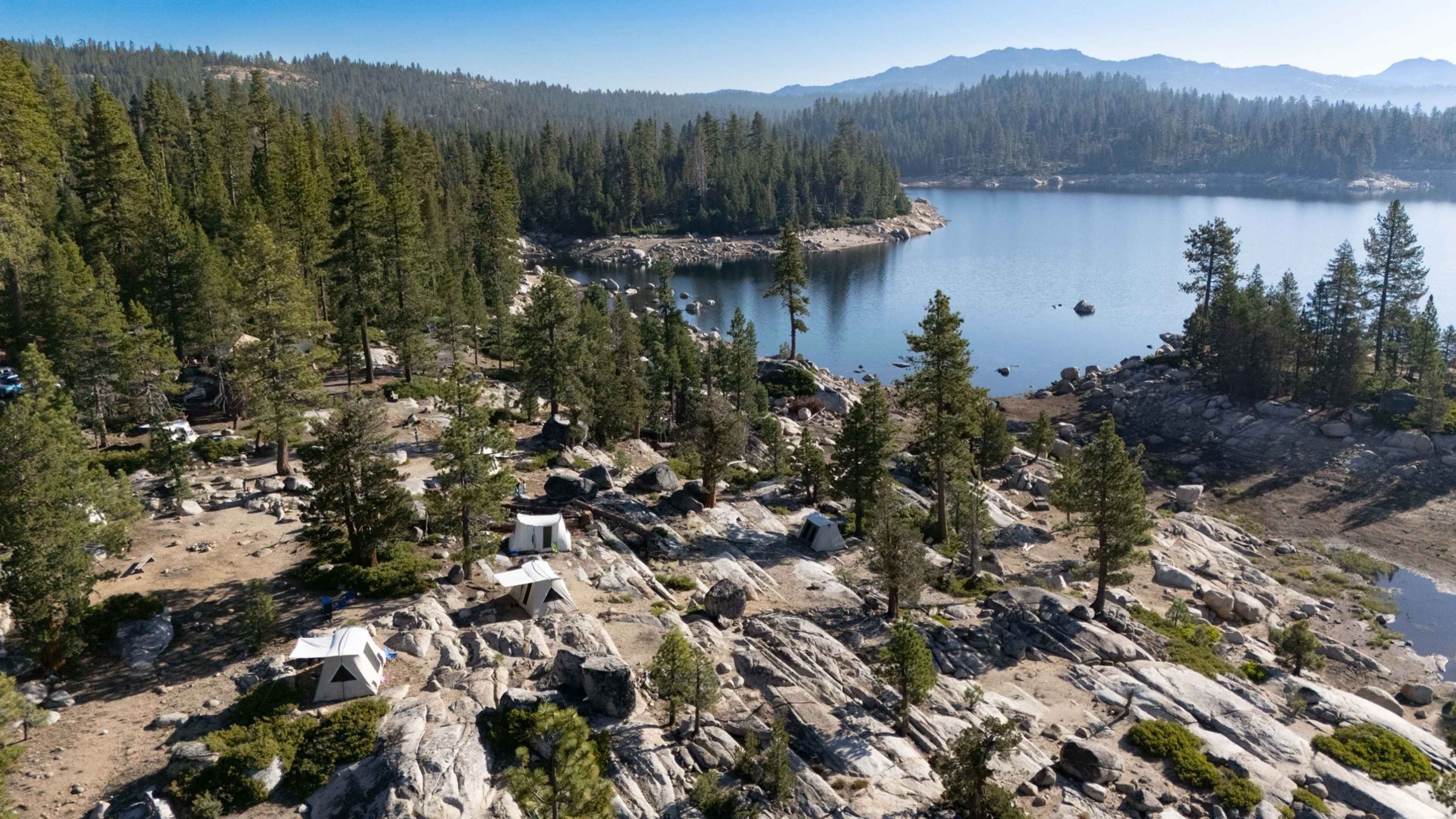
This August they finally earned their spot. We took a group of 45 people to the Spicer Reservoir group campground near Ebbetts Pass, into another heat wave, and the yellow jackets showed up the moment the bratwurst hit the grill. This time we stayed all four days. Here's what we've learned about meat bees in the years between those two trips, checked against what the research actually supports.
What Are Meat Bees, Exactly?
Meat bees are yellow jackets. In the Sierra, the one you're swatting at is almost always the western yellowjacket, and "meat bee" is such a settled California name for it that UC's statewide pest program uses it too. They aren't bees at all. They're wasps: angular, smooth, no fuzz, and built differently in one way that matters at a picnic table. A yellow jacket's stinger has no barb, so one wasp can sting you over and over.
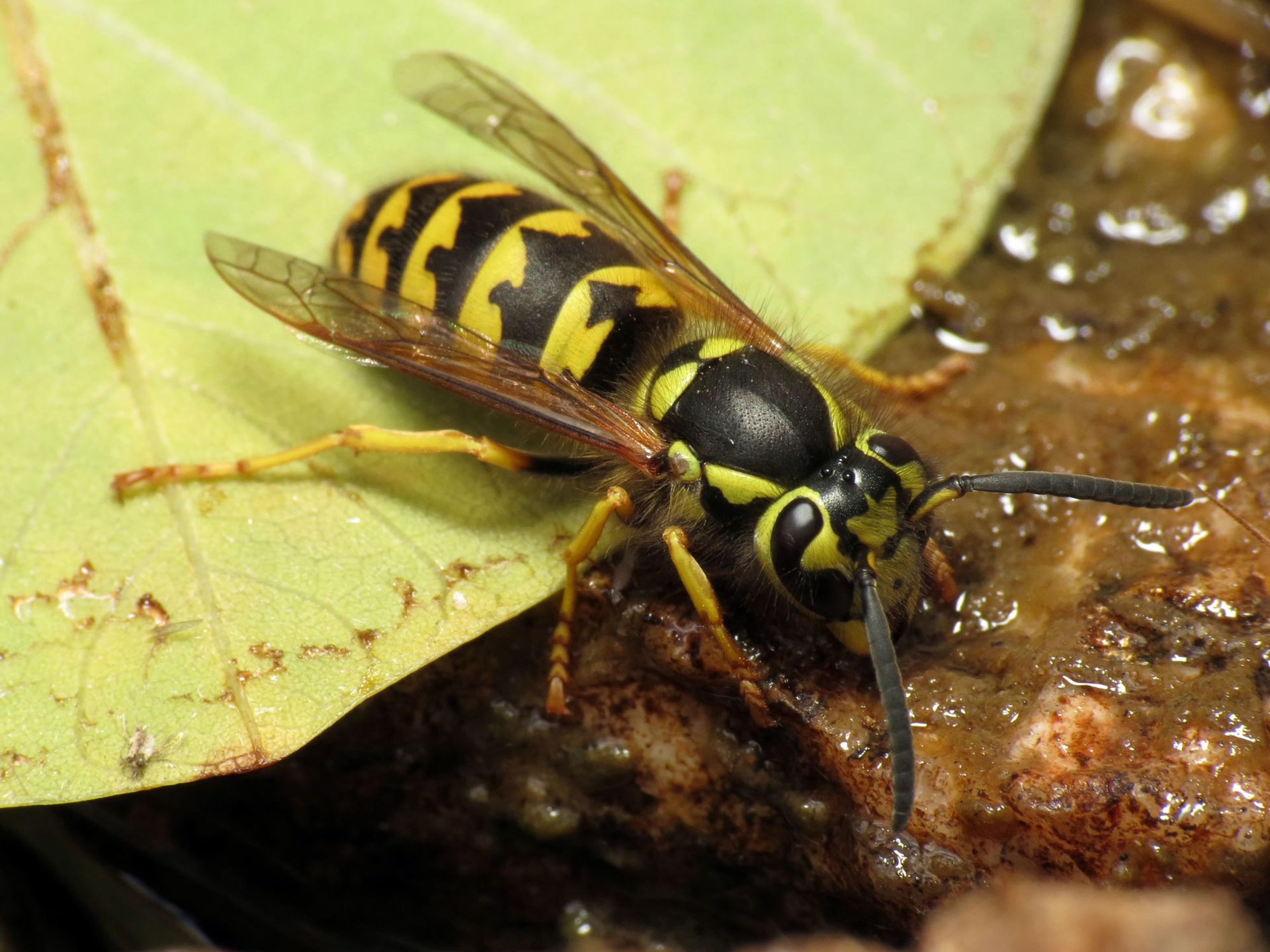
The western yellowjacket, the Sierra's meat bee, stopping at a water source. No fuzz, no barb: wasp, not bee. Photo: Katja Schulz, CC BY 2.0.
Did the Heat Wave Cause It?
My husband Justin's theory was that heat waves trigger them somehow. Both of our worst yellow jacket trips came during one, so he asked us to check the research. The evidence points earlier. A warm, dry spring lets more queens survive and found nests, and at one California site the catch fell 97.5 percent from one summer to the next after a harsh spring. Late summer is when colonies peak, every year's size set months before your trip.
Our two plague years fit that pattern almost too well. Spring 2021 brought record-early Sierra snowmelt and deepening drought; the winter before this trip ran warm and dry with the snowpack far below average. The wet or near-normal years in between, including 2023's giant winter, were the years we barely noticed a yellow jacket. Two trips prove nothing on their own, but they land exactly where the research says they should.
The heat itself probably worked against them: studies of a related yellow jacket species found extreme heat suppresses flight, with foraging dropping off as temperatures climb toward triple digits. Nobody has measured yellow jackets through a discrete heat wave, so we won't claim the heat made more of them. The year's supply was set back in spring. August just sat us all down at the same table.
The Traps: What Worked at New Spicer
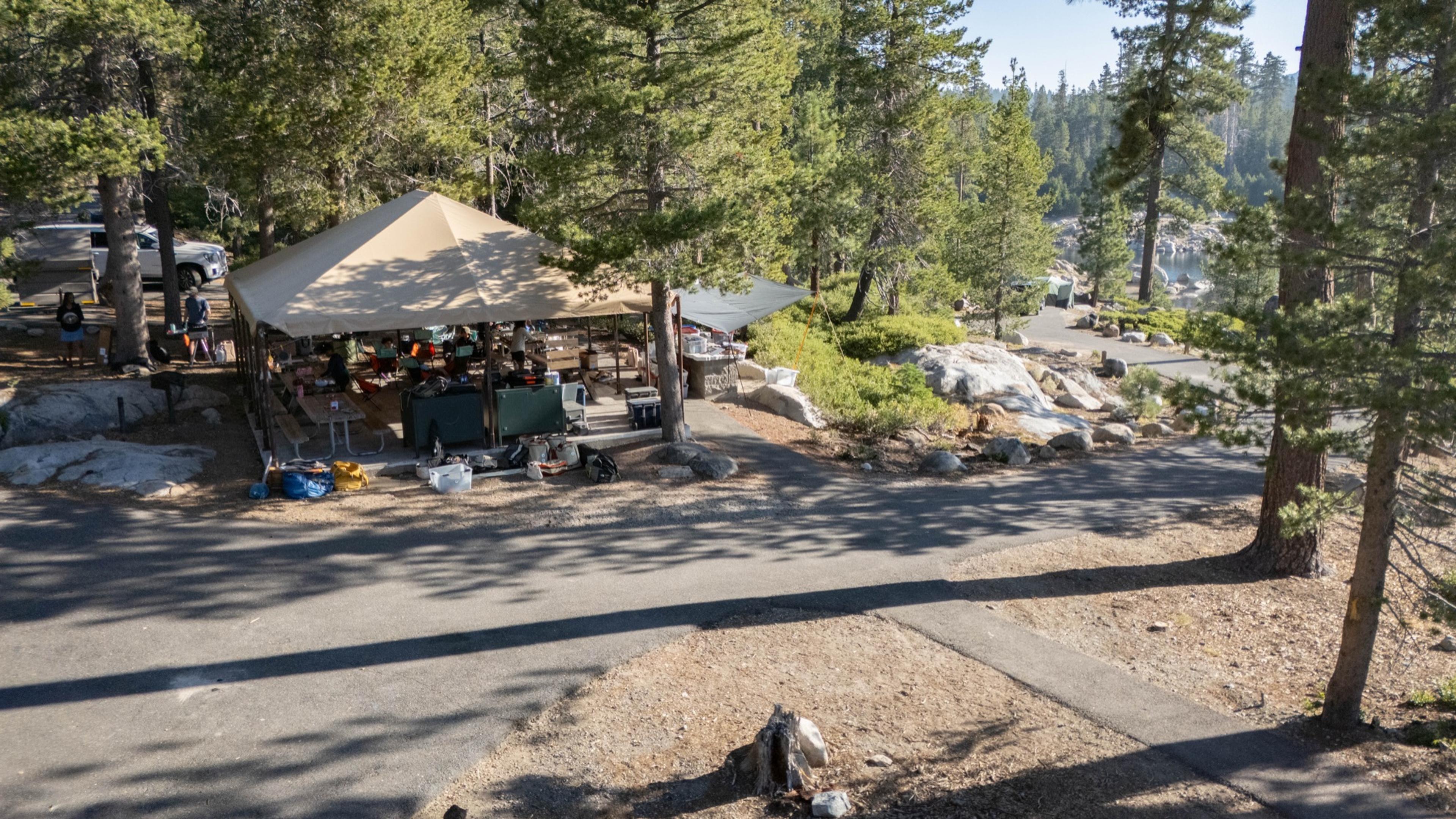
We rolled in Wednesday around 2 PM. Low 80s, and the yellow jackets were around but calm. In our experience they save their energy for mornings and evenings. The group site has a covered concrete slab, canvas stretched tight over a metal frame with six picnic tables and bear bins underneath, and hanging from it were somebody's old yellow jacket traps: mostly dried out, nearly empty. Remember those traps. They matter later.
Wednesday night we started dinner for 45 people, bratwurst with peppers and onions, salmon for the pescatarians. The moment the sausage hit the grill, the yellow jackets came. Not a stray wasp or two. A swarm, working the whole eating area.
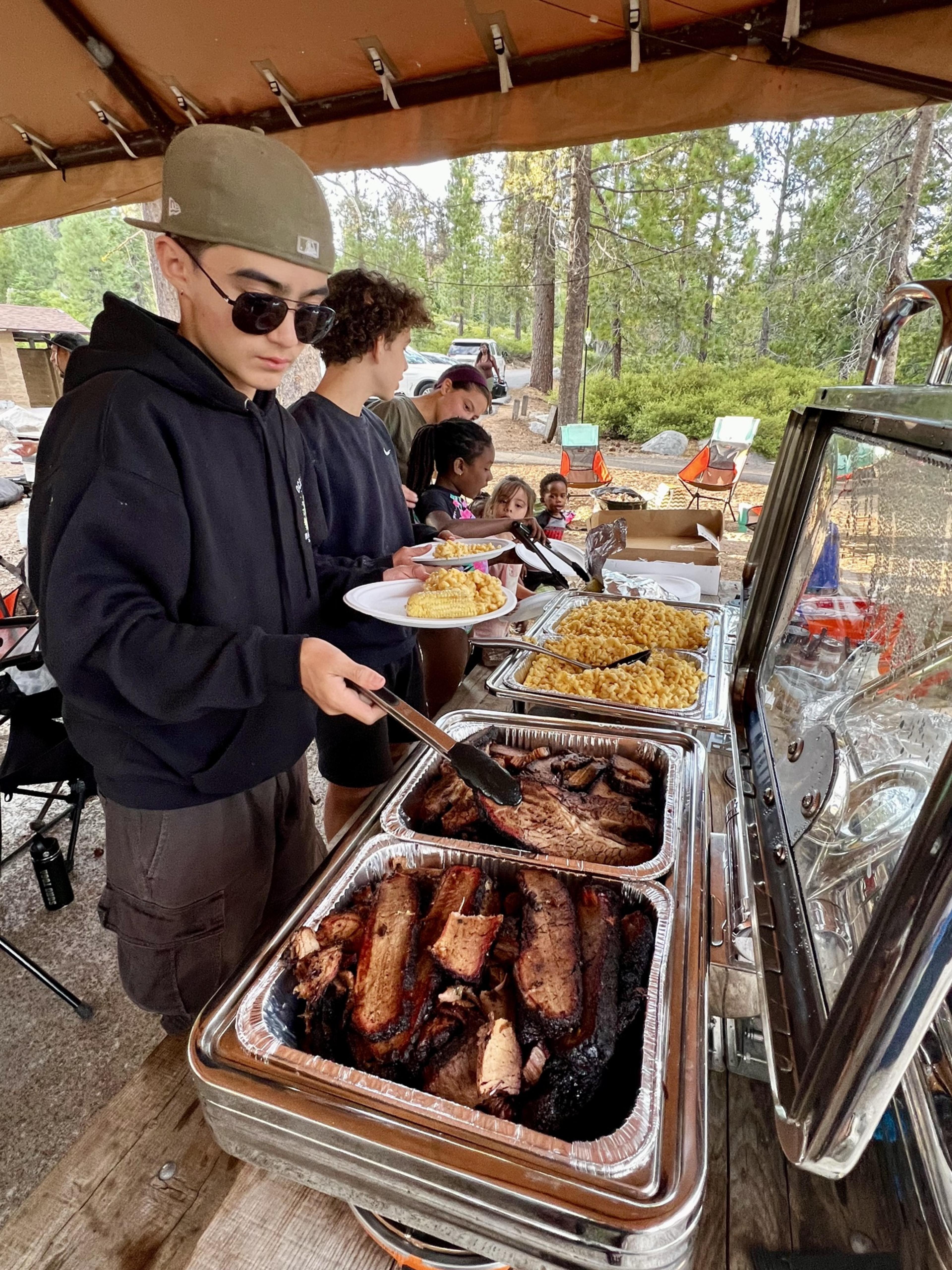
The serving line under the canopy. Every open tray is an invitation, and the yellow jackets accept.
So the traps we'd carried for five summers finally came out. Ours are the Disposable Summer Yellowjacket Traps (check price at Amazon). Inside each one is a packet of heptyl butyrate, a fruity-smelling attractant that western yellowjackets read as food. You cut open the top, fill the trap with water, and the packet dissolves; wasps follow the scent in through four ports, can't find their way back out, and drown. The packet normally takes a couple of hours to dissolve, and we had wasps on us immediately, so Justin started with a little water, massaged the packet through the outside of the bag until it dissolved, then topped the trap up. He tied four to the corners of the shelter with string. Within minutes, 15 to 20 yellow jackets crowded each one.
By Saturday, every one of our six traps held at least a half inch of yellow jackets settled on the bottom and another half inch floating at the top, some more. The gauge printed on the side says every half inch is roughly 300 wasps. Thousands, across the set. And still: that's local relief, not population control. Lure traps reduce foraging pressure but don't eliminate populations, and a single large nest can hold more wasps than we likely trapped all weekend. What they bought us was room to live. You could cook and eat, with a scout or two every ten or fifteen minutes instead of a swarm.
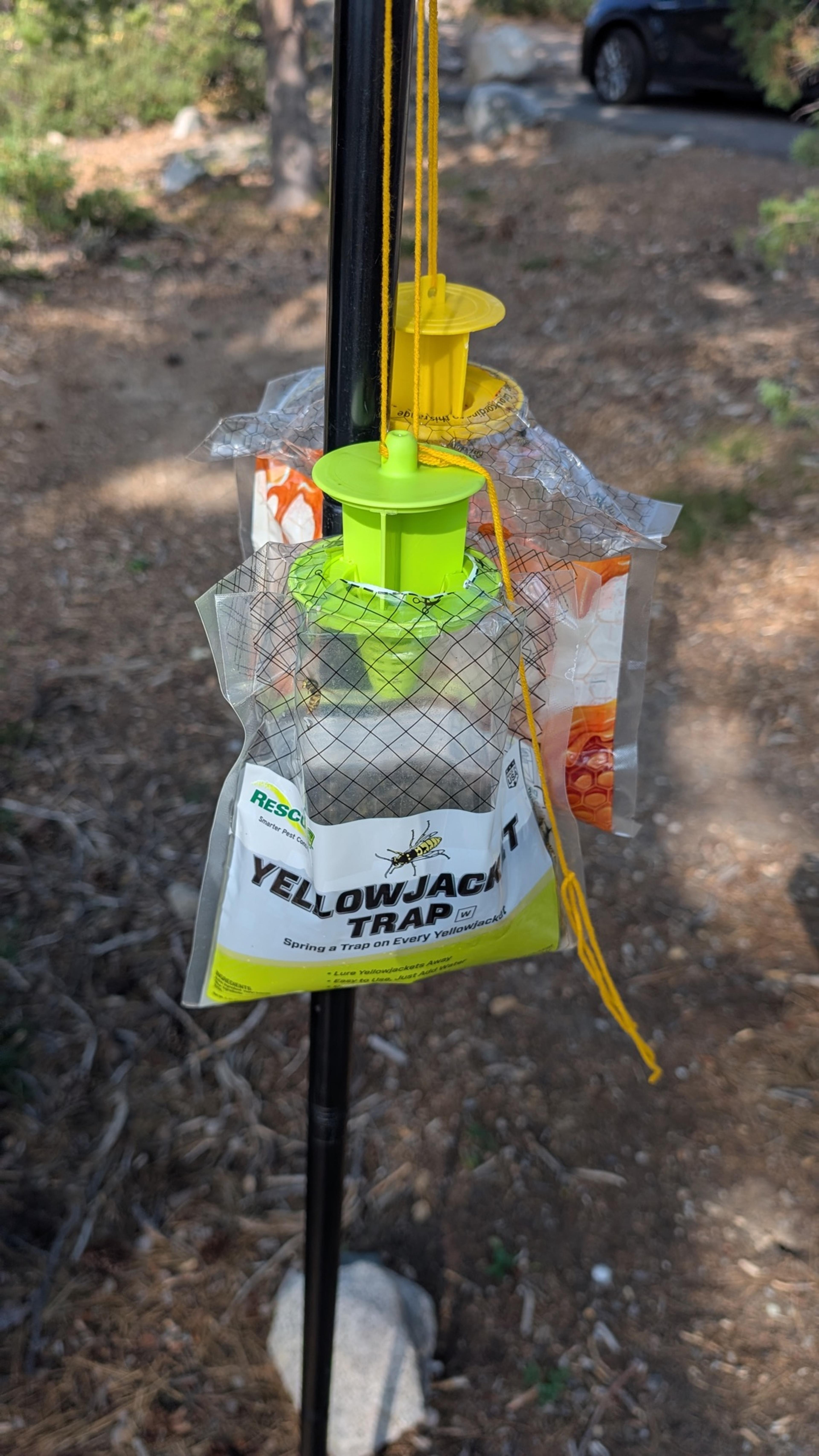
Two of the six, on one of our string-light stakes. The dark layer in the bag is yellow jackets. The gauge counts them in half inches, roughly 300 per mark.
Where to Put Yellow Jacket Traps (We Did This Wrong)
Hanging four lure traps over the place where 45 people were eating was a mistake. A lure trap is an attractant, and we'd pinned four invitations to the dining room roof. By Thursday morning Justin had moved them out 15 to 20 feet onto the metal torch stakes we normally use for string lights. The trap maker says at least 20 feet from human activity, and warns that closer placement can draw yellow jackets toward people. So only the far end of our move met their minimum.
The principle every source agrees on is interception: multiple traps around the perimeter, between your eating area and the wild ground where nests are, so foragers hit the lure on the way in. In one park-scale field test, researchers ringed a California picnic pavilion with 50 traps about 200 feet out. The ring caught nearly 6,000 yellow jackets; the pavilion caught 208. A six-trap camp setup can't build that wall, but the direction holds, and closer spacing between traps may improve the interception.
And the wasps already inside your perimeter? A trap was never going to pull a yellow jacket off your bratwurst; it catches the ones still on their way in. In that study, monitors at the pavilion still averaged around five wasps per trap per day while the ring traps averaged 45. The stragglers are what food discipline is for: cover dishes, close the bear bins, pick up dropped food, and brush the persistent ones away gently.
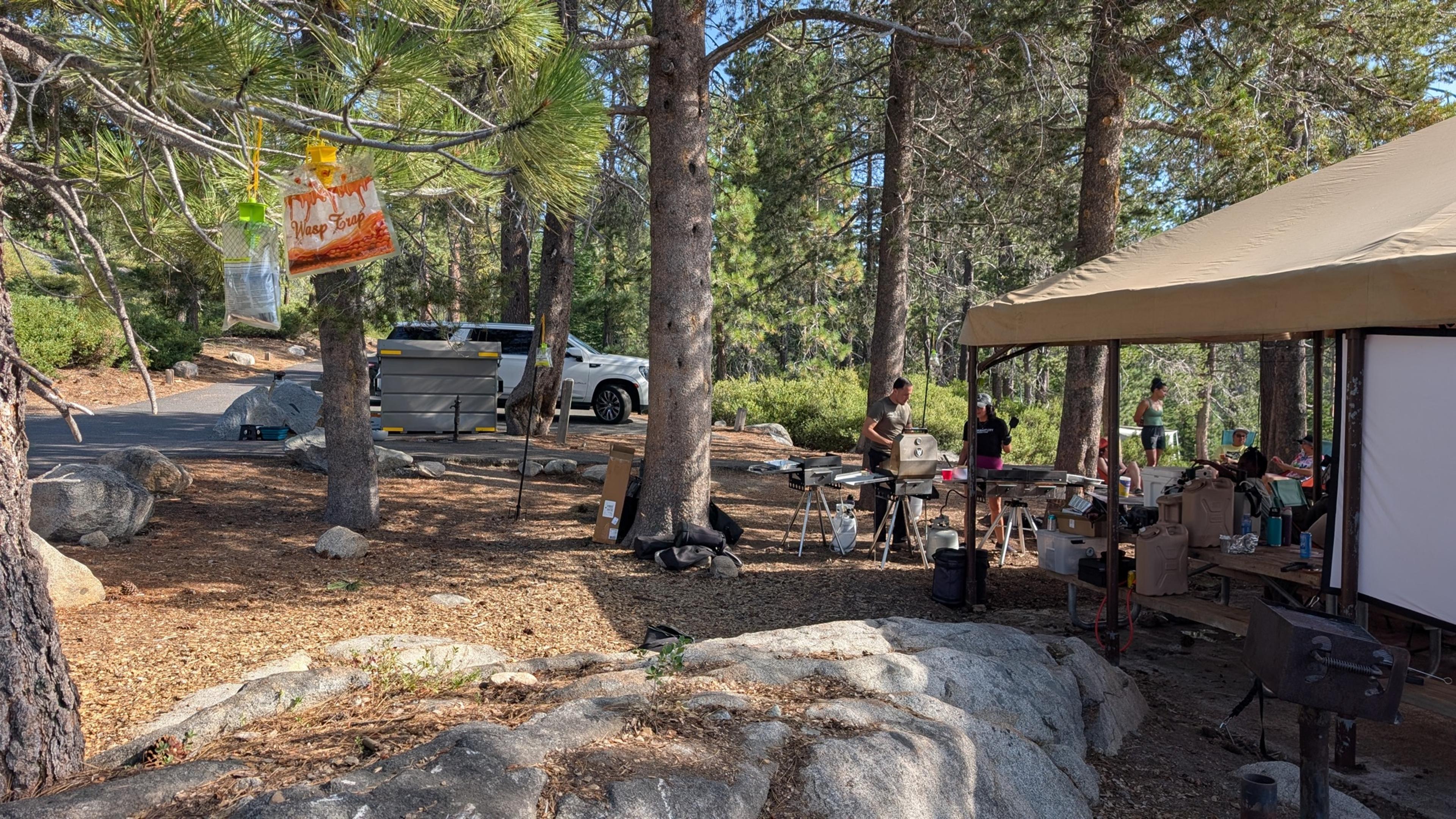
The corrected setup: traps at the edge of camp, dining canopy in the distance. Foragers hit the lure before they find the tables.
Those dried-out traps hanging there when we arrived? Expired. The lure lasts two to three weeks, and in the pavilion study, catches at the tables jumped the week a lure dried out. Skip spring queen trapping too: two California field studies found trapping queens all spring did nothing to late-summer worker numbers. Save fresh traps for the trip.
What Doesn't Work
- Bug spray. DEET and picaridin are tested against mosquitoes and ticks, which hunt you by scent. Yellow jackets are after your lunch, not your blood, and no effective repellent products exist for them. The picaridin we recommend in our mosquito guide does nothing here.
- Swatting hard. Fast movements attract more yellow jackets, and a crushed one releases an alarm pheromone that recruits others. Staying calm and gently brushing away a wasp that lands is as far as you should go.
- Wasp spray at the swarm. Those wasp-and-hornet aerosols are nest treatments: a jet you soak a stationary nest with, at night, per the label. Fired at foragers around your table, you're misting insecticide over the place you eat to kill the few you manage to hit, and labels prohibit contaminating food or the surfaces food touches. At a campground, even a real nest is the host's or ranger's call.
If There's a Nest Near Your Site
A few summers back at Pfeiffer Big Sur, two of the kids got stung walking our site's trail down to the river, and we couldn't figure out why. Justin found the cause the next day: a tiny ground-nest opening in the hillside, five to ten feet off the path, visible only by the steady traffic of yellow jackets in and out.
Planning where to go next? Camp Sage knows every campground we track. Ask it anything, from drive times to which loops have shade.
Ask Camp SageThen he did the thing you should not do: dropped a large rock over the opening to protect the kids. A rock can't seal a tunnel in the dirt. There are gaps a wasp walks right through, and the nest itself, a ball of comb buried beyond the tunnel, is untouched. All you've done is announce an attack, and the colony answered: they swarmed him, stung him, and followed him from 20 feet out.
Later, reading by the river 50 to 100 yards away, a passing yellow jacket, probably picking up the alarm pheromone the first attackers had left on him, flew straight down Justin's swim shorts and stung him again. The marking is real. Attacking yellow jackets deposit an alarm pheromone on their target, and in one experiment, marked targets still drew attacks 15 hours later.
The camper's answer is distance. Give the nest a wide berth and tell the host or ranger; nest removal isn't practical for a camper, and at home the right call is professional help or your local vector control district. If a nest defense finds you, cover your face and get to a vehicle or building fast. One curious wasp is a stay-still situation. A nest defense is a run situation.
When Someone Gets Stung
Five people in our group got stung at New Spicer, mostly by accident: a hand grabbing a piece of food, a foot too close to a wasp on the ground. The pain is immediate and serious, and with no barb they can sting repeatedly, especially one trapped in loose clothing. We treated ours with ice and ibuprofen. The fuller first-aid playbook is close to that: wash with soap and water, ice it, don't scratch, and use an over-the-counter pain reliever or antihistamine for symptoms. Check open cans and cups before you drink; a sting in the mouth or throat is an emergency for anyone. Call 911 for trouble breathing, throat or tongue swelling, hives spreading beyond the sting, or dizziness, and use a prescribed epinephrine auto-injector immediately if one is available. Don't wait to see whether an antihistamine helps. Serious reactions can happen to people with no known allergy.
Frequently Asked Questions
Are meat bees the same as yellow jackets?
Yes. "Meat bee" is the common California name for yellow jackets, especially the western yellowjacket that dominates the Sierra. They're wasps, not bees: angular and smooth where bees are round and fuzzy.
Are yellow jackets aggressive?
Around their nest or in late season, yes. Defensive behavior increases as colonies grow through the summer and food gets scarcer, and unlike a honey bee, each yellow jacket can sting repeatedly. Away from the nest, a foraging wasp mostly wants your food. Stay calm; if one lands on you, brush it away gently or hold still until it moves on. Swatting, crushing, and panicking make things worse.
What attracts yellow jackets to a campsite?
Meat first. California researchers found protein is their primary food, still pulling hard in September, with sugar close behind: grilling meat, dropped food, open trash, soda cans, and in drought heat, any water source, down to the drips at a campground spigot. With 45 people, at least half of them kids, dropping food for four days, our group site was a buffet. Cover the bratwurst as carefully as the lemonade, close the bear bins, and police the ground under the tables.
Do yellow jacket traps actually work?
For taking pressure off an eating area, yes. We watched ours absorb a swarm within minutes. They don't control the population. The standard heptyl butyrate lure mainly attracts the western yellowjacket, conveniently the Sierra's main offender. Put multiple traps on the perimeter, at least 20 feet from people, between camp and wild ground.
Do electric fly swatters work on yellow jackets?
On the one you hit, yes. As a strategy, no. A zapped wasp can release the same alarm pheromone a crushed one does, which calls for backup, and swinging one anywhere near a nest is volunteering for a mass defense. For the stray scout at the table, we'd still rather brush it away and let the traps and food discipline do the real work.
Why are yellow jackets so bad in August?
Colonies start from a single overwintered queen in spring and can grow to 1,500 to 15,000 wasps by late summer. By August the hills have dried out, nectar is done, insects are thinner, and the colony has mostly stopped raising the young it was hunting protein for. That leaves the year's maximum number of wasps with the year's minimum natural food, and your table is the substitute. How bad a given August gets is mostly set by the previous spring's weather.
Do yellow jackets come out at night?
No. They're daytime foragers that go quiet after dark, and in our experience the foraging starts right at sunrise, which is why that dawn buzz at Oak Hollow was our wake-up call, and why pest professionals treat nests at night while the colony is home and calm.
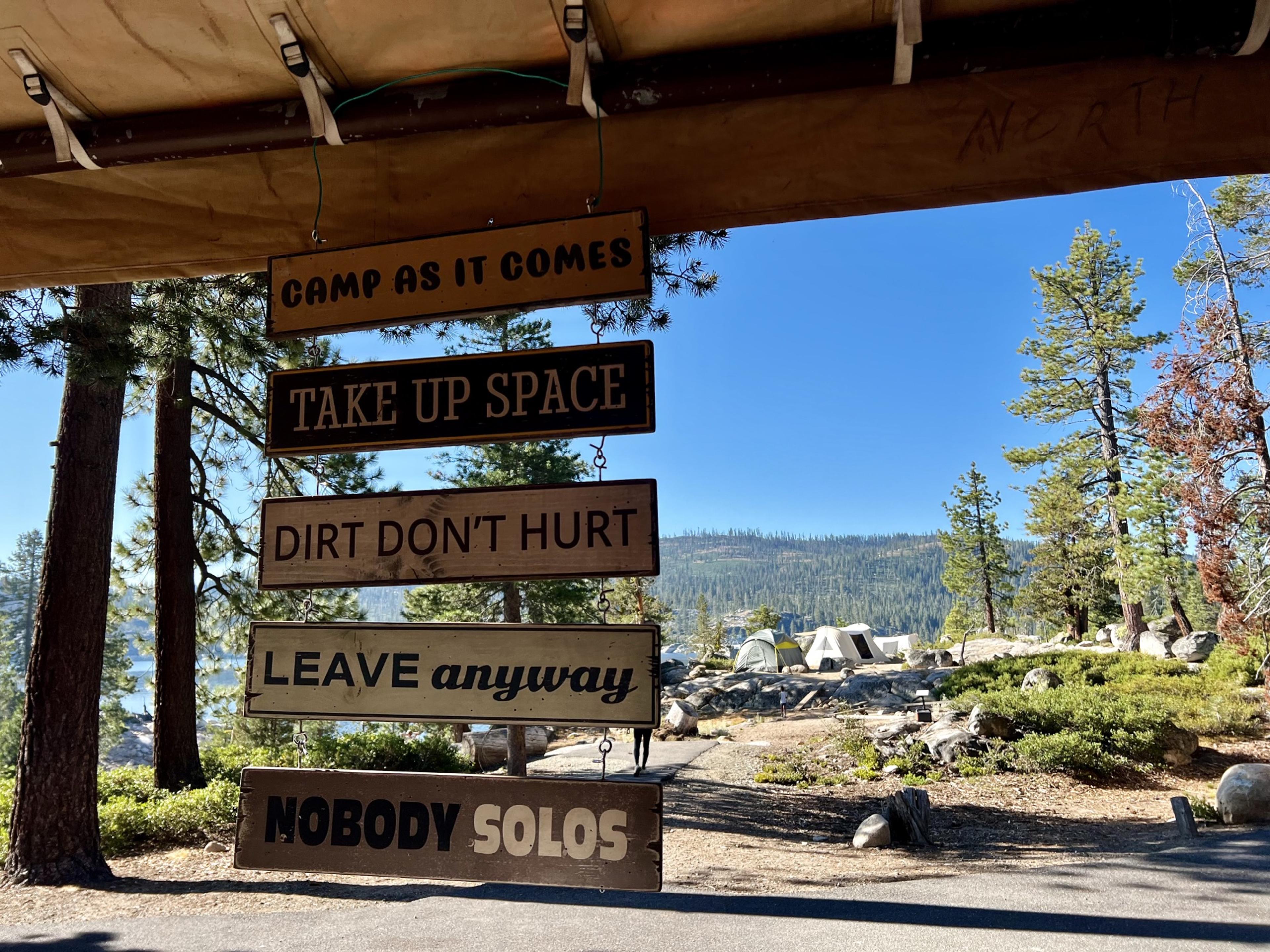
The house rules, hung at camp above the reservoir. Two of them did a lot of work this trip.
That New Spicer trip was a 45-person group booking made a year in advance. How we plan trips at that size is in our group camping guide.
That dawn sound at Oak Hollow ran us off a night early. At New Spicer the yellow jackets didn't change. We did. Forty-five of us cooked, ate, got stung a little, and stayed until Saturday. Some of the group ended up eating in their cars, and Justin's one regret was not having a screened tent we could set up to eat in. The traps, at least, finally earned their place. Camp as it comes.

Want a personalized version of this guide?
Camp Sage tailors recommendations to your dates, group, and gear — free.
Join our newsletter to get more resources and tips to help your family camp with confidence!