How to Build a Campfire (The Way Uncle John Built One at Williams Grove)
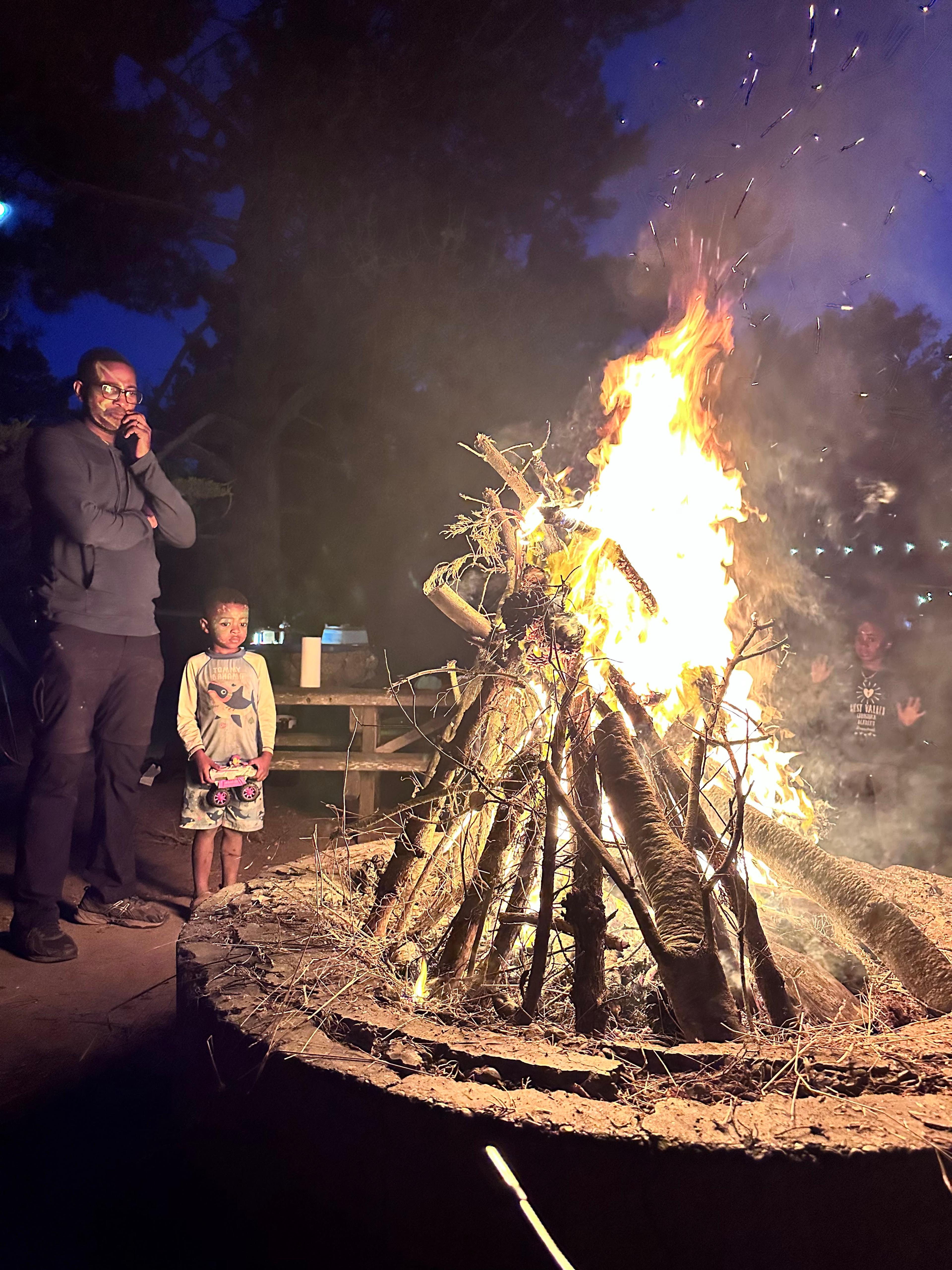
John and his son at Williams Grove, Humboldt Redwoods State Park

Williams Grove sits inside Humboldt Redwoods State Park. The group site holds 60 people easily and you get the whole grove to yourselves. Several fire pits spaced across the campground, old-growth coast redwoods overhead, downed branches everywhere in early summer.
Our first night there, John was on his first Outdoorithm Collective group trip. His family had camped once before. Wife and three kids in tow, all still finding their feet. Turns out John loves making campfires. He recruited the kids to forage downed wood, walked the grove for ten minutes, came back with armfuls of dry branches sized perfectly small to large. By the time most of us were still unpacking, he had a teepee fire stacked four feet tall and starting to roar.
Meanwhile we set up two propane fire pits near the main picnic tables. Smoke-free option for folks with kids and asthma and tents in the path of the wind. Thirty people were already around them, laughing, making s'mores, kids running between the picnic tables and the parents.
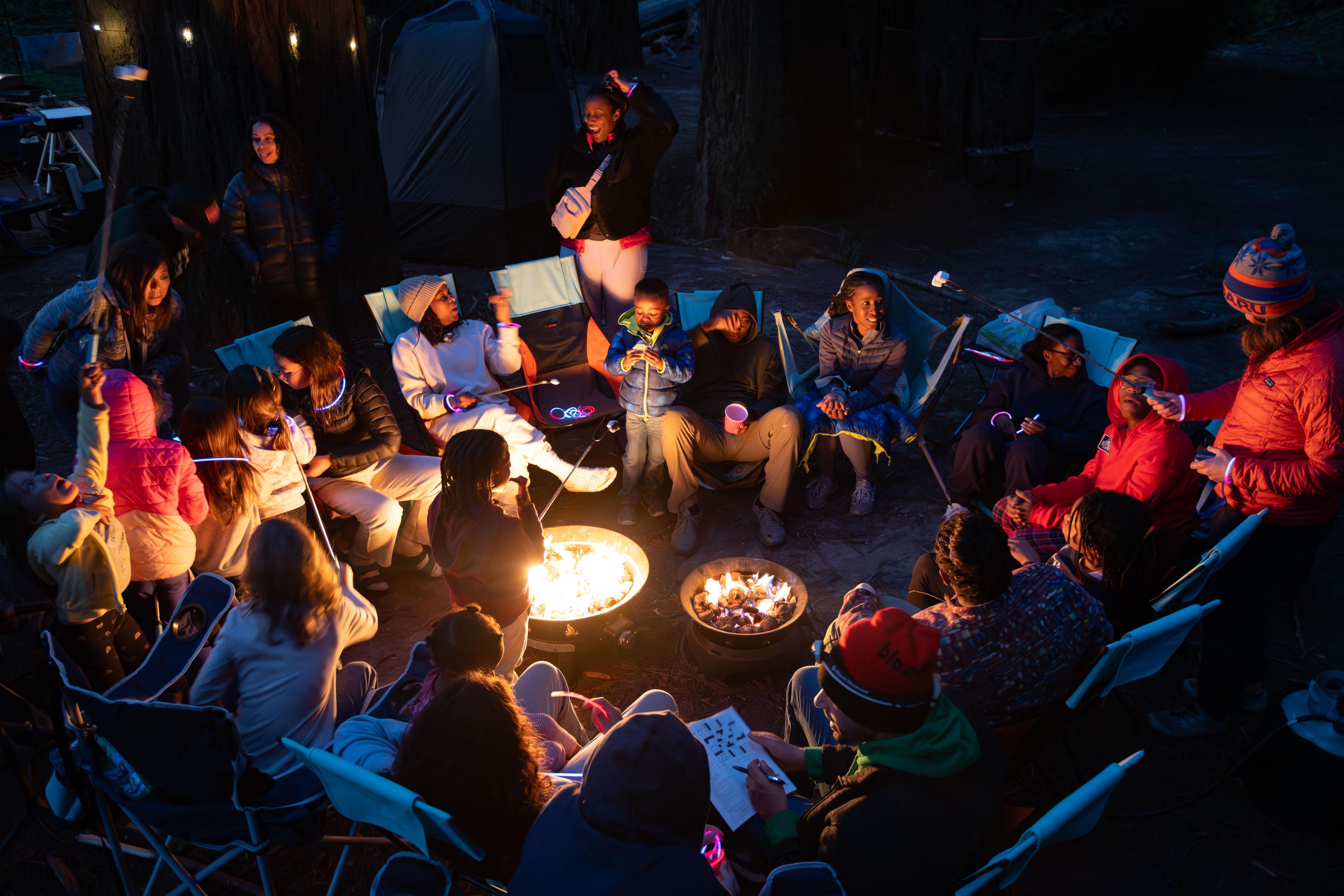
Then John's fire really caught.
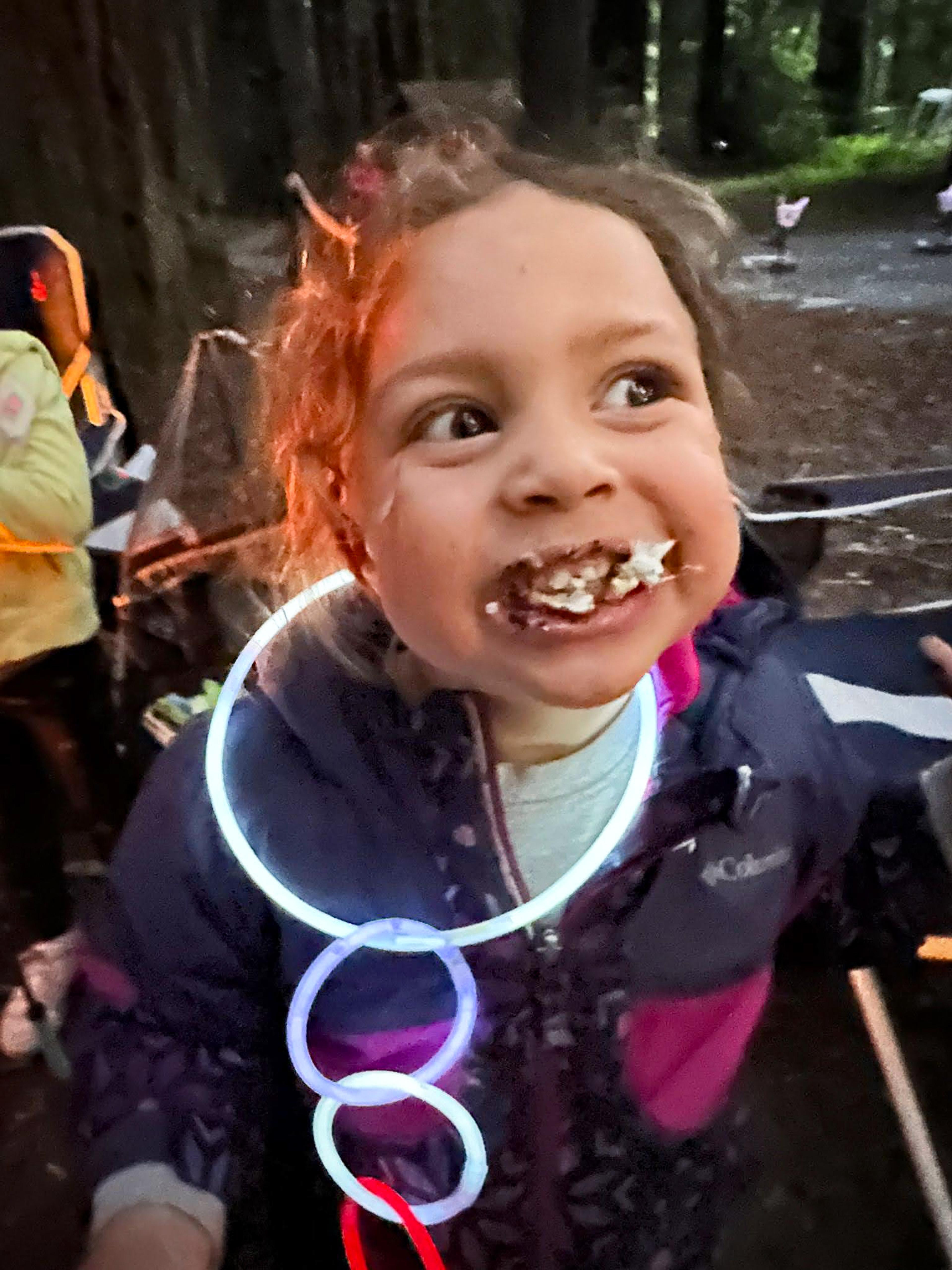
Eliza was three. She had met John exactly once, the day before. The instant she saw real flames against the redwoods, she announced she was going to "Uncle John's fire." Within a minute, every kid under ten had migrated. The propane pits were still going strong. They just weren't the same thing.
There's something about a real campfire you can't replace. We love our propane fire pits. We use them on group trips, at beach campgrounds during fire bans, on windy nights when sparks are a problem. But we try to have at least one real fire on every group trip, because Eliza's instinct that night was right. The light moves differently. The wood smells different. People sit closer.
This is how to build one that actually does what John's did. Not the version that smolders for an hour and drives everyone into the tent.
What most campfire guides get wrong
Every campfire guide on the internet leads with teepee versus log cabin versus lean-to. The structure doesn't matter that much. We've watched a hundred campfires across the last fifteen years and the difference between a fire that lights on the first match and a fire that ruins dinner is not the shape.
It's three things, in this order:
Wood quality. Dry, seasoned, sized in three piles before you light anything.
Airflow. Gaps in the structure, no matter what shape it is.
Patience. Most failed fires got poked too early.
Get those right and any structure works. Get them wrong and the most beautiful teepee in the world will smoke itself out.
How to build a campfire, step by step
Step 1. Pick the spot
Use the campground's fire ring or pit. Always. If there isn't one and you're backcountry where fires are permitted, find bare ground or rock, 15 feet from anything that can catch. Tents, picnic tables, low branches, dry grass.
Check the fire restriction status before you go. Most California state parks have summer fire restrictions that change weekly. National Forests post fire orders. The rule is the rule, even if your neighbor is breaking it.
Notice the wind direction. Sit upwind. Put the tent farther upwind still. We learned this at Bodega Dunes after a windy night where every piece of clothing we owned smelled like campfire for three days.
Step 2. Get the wood right
Buy local firewood. Most campgrounds sell it at the entrance for $7 to $10 a bundle. The point isn't price. The point is that bringing wood from home moves invasive bugs into forests that don't have defenses. Emerald ash borer. Gypsy moth. Some parks fine you for it. All parks ask you not to. Local wood is also pre-seasoned, which matters more than people think.
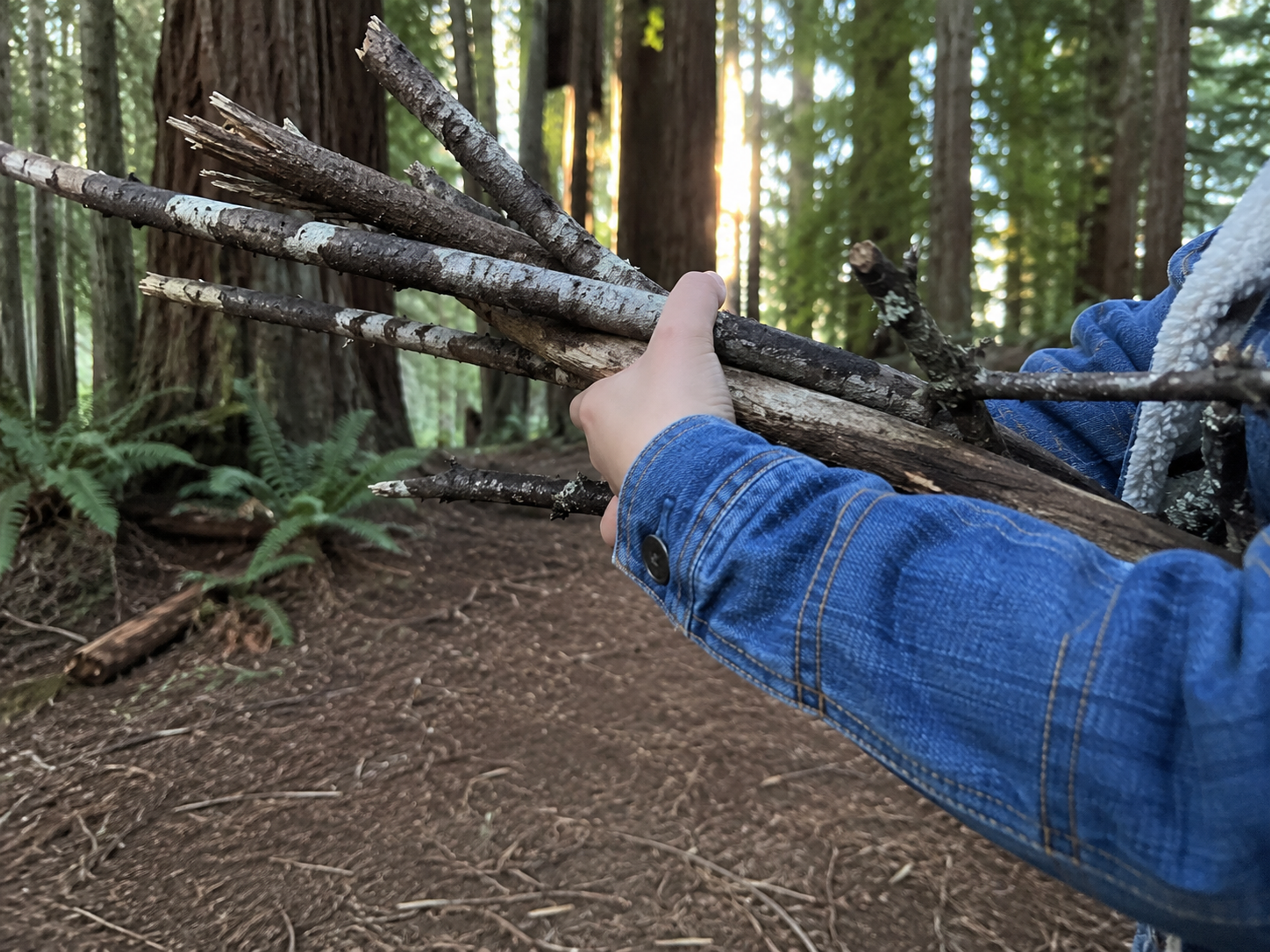
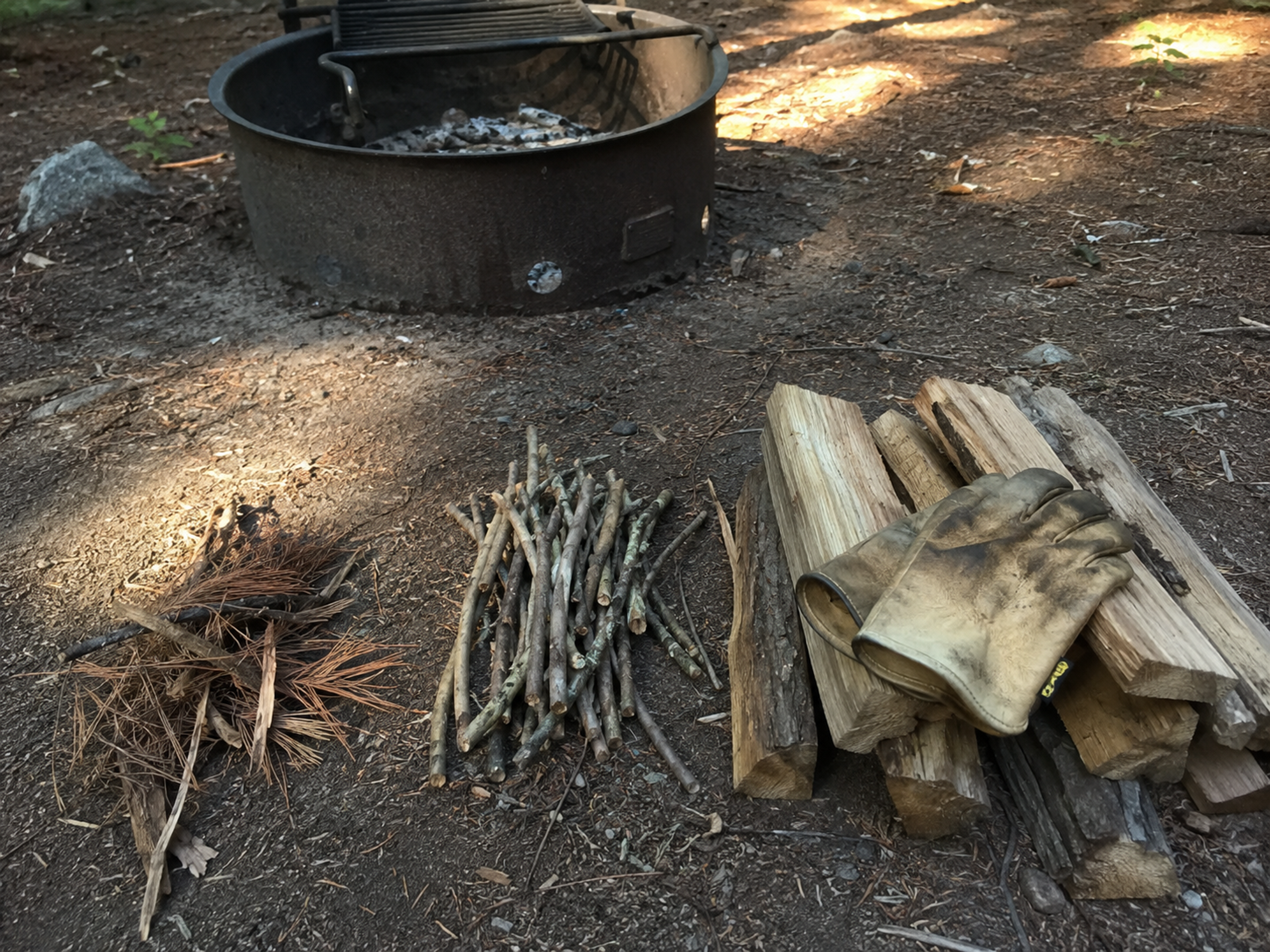
Sort the wood into three piles before you light anything:
Tinder. Dry pine needles, dry leaves, paper-thin bark strips, dryer lint, or a commercial firestarter. Tinder catches a spark and burns hot for ten to thirty seconds. You need enough of it. A fist-sized pile minimum.
Kindling. Pencil-thick to thumb-thick sticks. These bridge tinder to firewood. The kindling pile should be larger than the tinder pile and twice the volume of what you think you need.
Firewood. Wrist-thick to forearm-thick split logs. Dry. Cracks at the ends mean it's seasoned. If wood hisses or steams when it burns, it's too wet and the fire will smoke.
For wet conditions or backup, keep UCO Sweetfire firestarter tinder in a Ziploc in the firewood bin. It's wax-coated sugarcane that lights soaking wet and burns for seven minutes. We learned its value at Pfeiffer Big Sur in a December rain when everything we'd gathered was a sponge.
Step 3. Stack for airflow
Teepee for fast light. Log cabin for sustained burn. Most experienced campers do both. Teepee inside, log cabin around it.
The build:
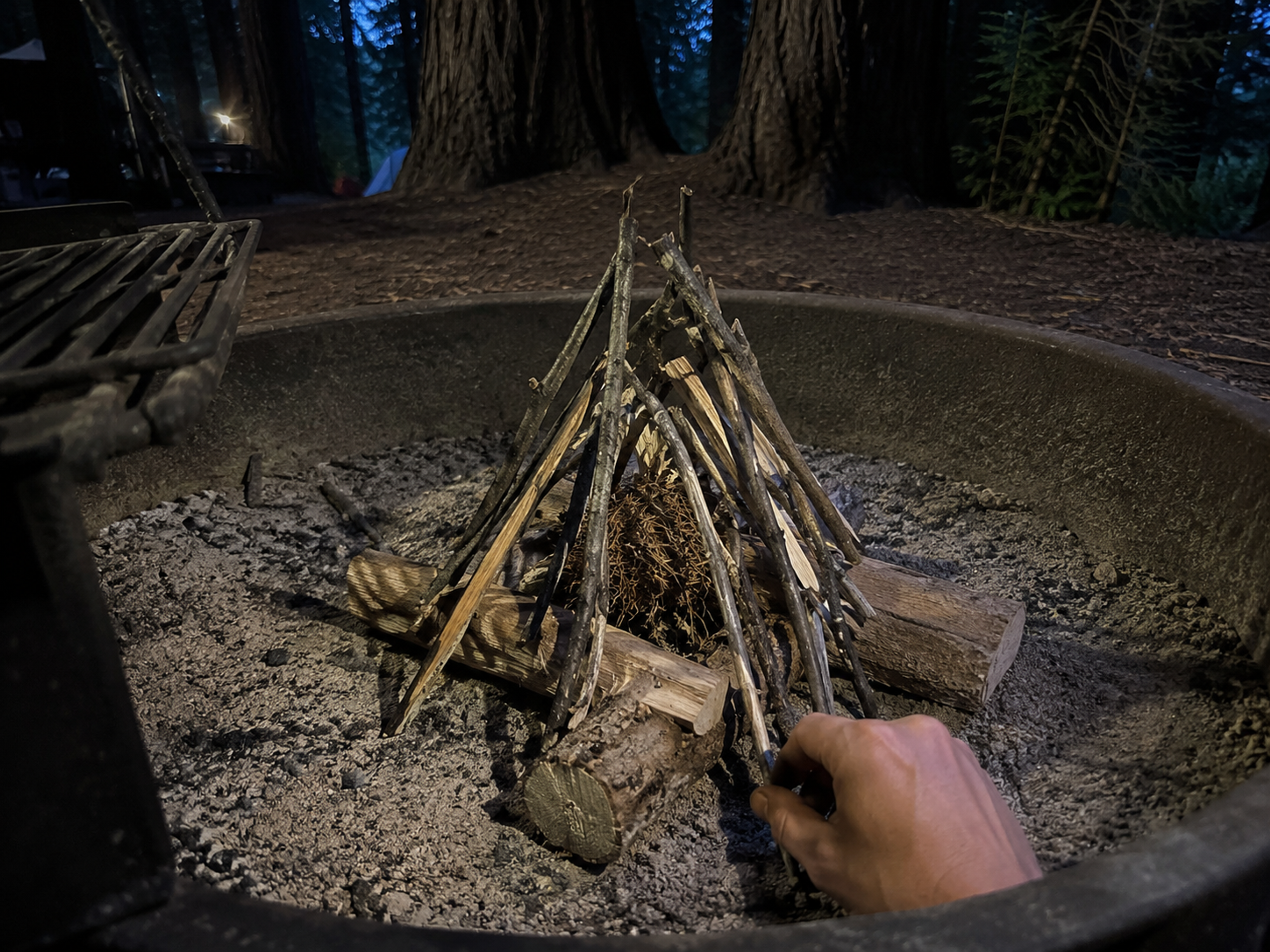
Put your tinder pile in the center of the fire ring. Stand kindling around it in a cone shape, leaning inward, leaving a finger-width gap between every stick so air can move. Around the kindling teepee, lay two parallel firewood logs as a base. Then two more across them at right angles. Two layers of log cabin is plenty. The opening between the teepee and the log cabin is where you'll light.
Don't pack it. Air kills smoke. A fire starved of air smolders, smokes, and drives everyone away.
If you're foraging downed wood like John did, look for branches that snap cleanly when you bend them. Anything that bends without breaking is too green. Dry redwood and dry pine both work. Cedar lights fast but burns fast. Oak holds heat the longest if you can find it.
A small hatchet earns its weight on group trips when you need to split kindling fast. The Gerber Gator Combo Axe II comes with a saw stored in the handle, which is how we processed a downed branch into a week's kindling at an Indian Cove group trip last spring.
Step 4. Light it once
Light low and at multiple points around the tinder. Heat rises, so a flame at the bottom catches the whole structure faster than a flame at the top. Cup your hand to shield the flame from wind for the first ten seconds while the tinder takes.
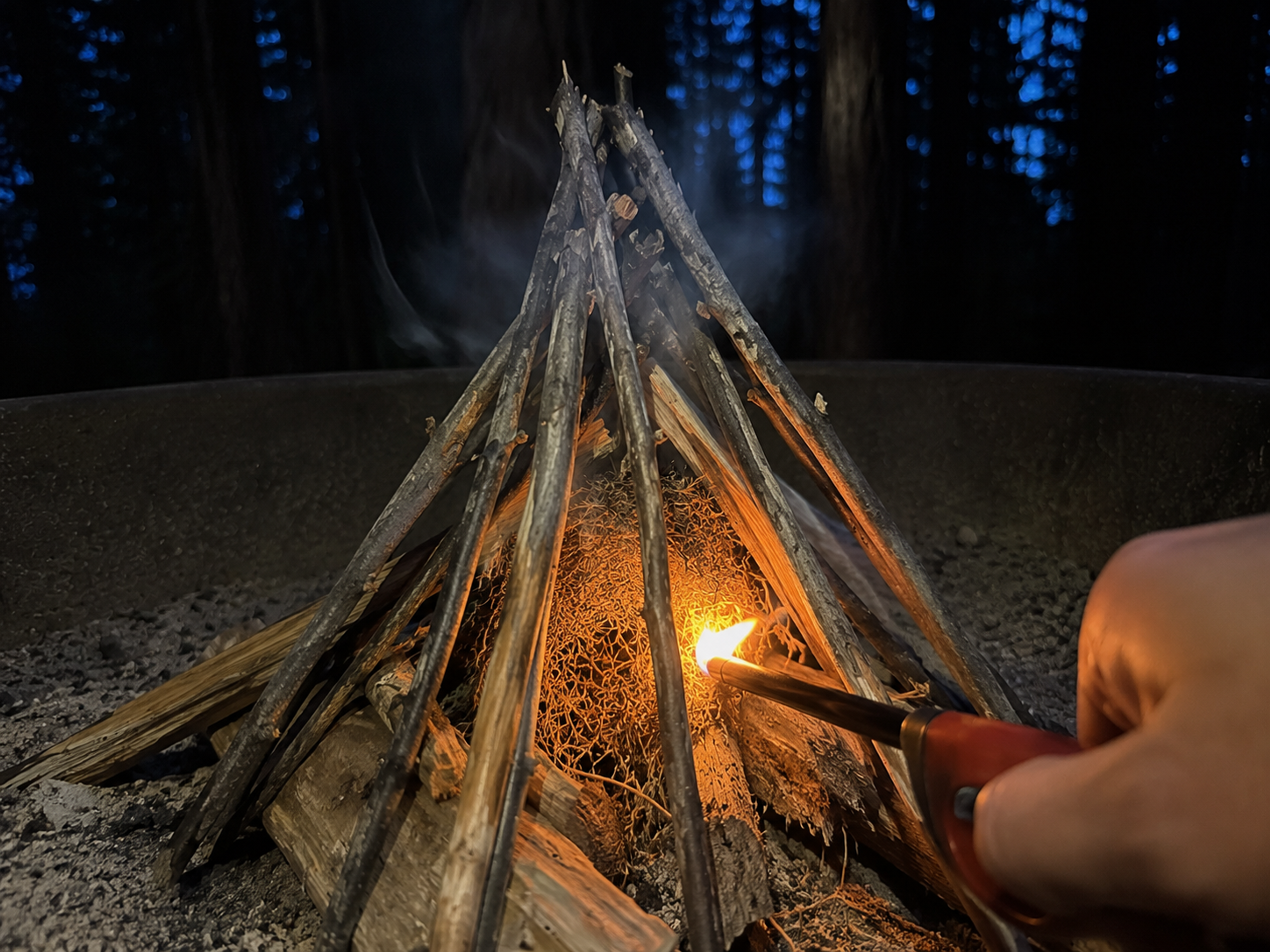
Use a long lighter, not stovetop matches. The Exotac titanLIGHT refillable lighter is the one we've carried since 2019. Wind-resistant, refillable with regular lighter fluid, machined aluminum body that survives being dropped in dirt over and over. Cheap disposable lighters die at the bottom of every cooler eventually.
Never use accelerants. No gasoline, no lighter fluid, no white gas. People lose eyebrows this way. The hot tinder will catch the kindling, the kindling will catch the firewood. Trust the structure.
Step 5. Feed it patiently
Once flames are climbing the kindling, leave it alone. Don't poke. Don't rearrange. The most common mistake at this stage is moving sticks around because the fire "isn't doing enough," which collapses the airflow channels you built. The fire knows what it's doing. Give it three minutes.
Packing for a trip? Our free interactive checklist tracks everything, tent to toothbrush, so nothing gets left in the garage.
Open the camping checklistWhen the first logs are burning down their length and not just at the ends, you can add another log. Add it on top of the existing structure, parallel to the prevailing flames. Add one log at a time. Two logs at once smothers.
How to keep the smoke down
Smoke is unburned wood. Combustion is incomplete. Fix combustion, fix smoke.
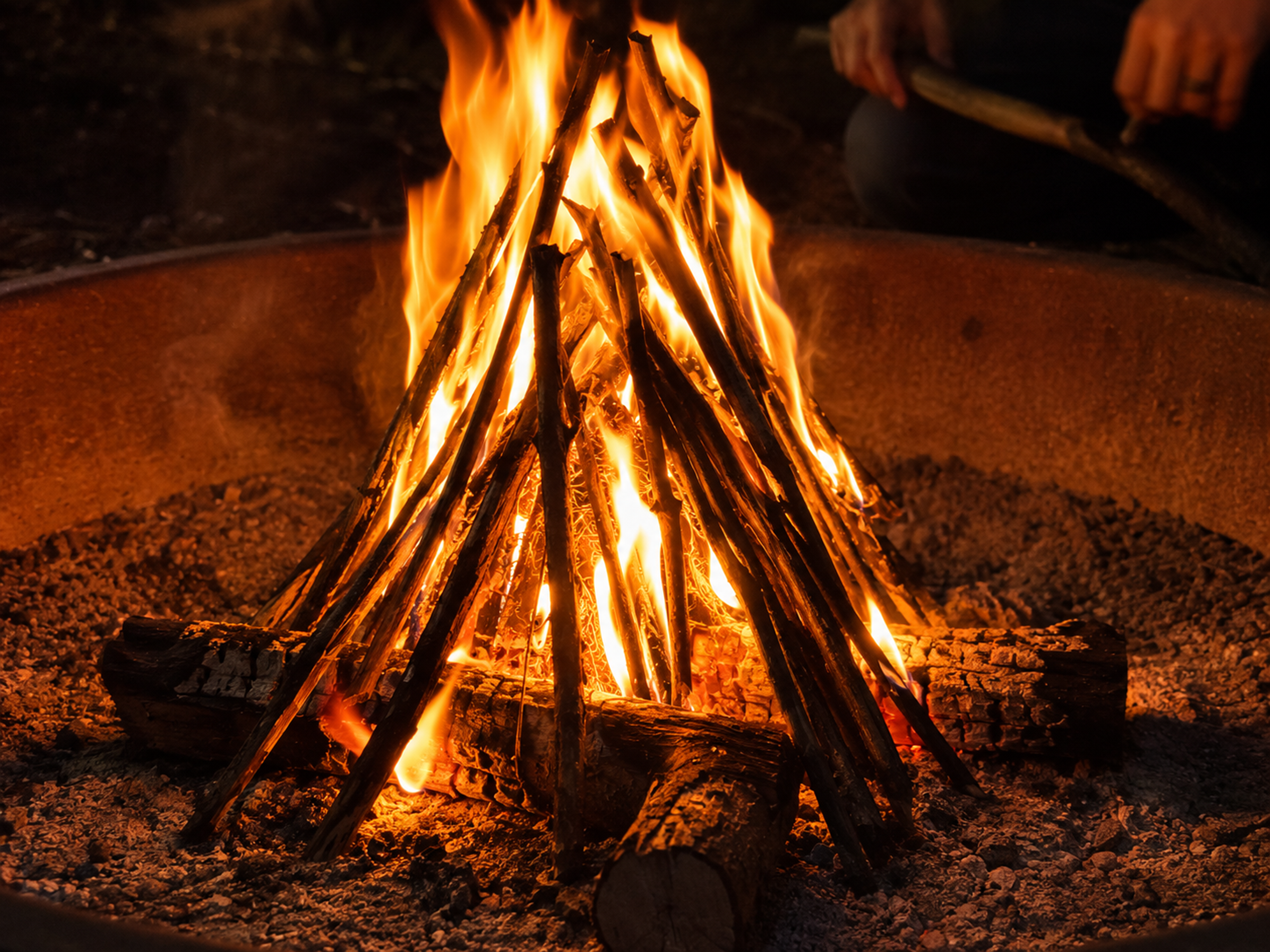
In order of impact:
Dry wood. Wet wood is the single biggest cause of smoke. If the wood hisses when it burns, it's too wet. The water has to boil out before the wood will burn cleanly, and all that steam carries unburned particles. Local campground wood is usually fine. Beware of free piles people leave at campsites. That wood has often been rained on for weeks.
More air. A smoky fire is a starved fire. Spread the logs slightly to open airflow. Or use a small bellows or a lid to fan the base. Restart momentum at the bottom of the fire.
Burn hot. A small, slow fire produces more smoke than a robust one. Don't let it die down and then try to resuscitate it with more wood. Build it back up with kindling first.
Wood species matters less than you think. Hardwood burns cleaner than softwood when both are equally dry. Pine smokes if wet, burns clean if dry. Don't overthink this.
Sit upwind. This is the unsexy answer that solves 90% of "the smoke keeps following me" complaints. It actually follows airflow. Wind blows from northwest at Bodega Dunes most evenings. Sit southeast of the fire. You'll be comfortable.
The fire that taught us patience
One December at Pfeiffer Big Sur. Cold, wet, dark by 5:30. We pulled in late, set the tent up first, started the fire second. The firewood the camp host sold us was barely dry. The tinder I had wouldn't catch with one match, so I tried two more, then a wad of newspaper from the cooler. I kept rebuilding the teepee, kept pulling logs apart and stacking them differently, kept making it worse.
Justin watched. He didn't say anything for about ten minutes. Then he asked, quietly, if I had stopped to feel the wood. I hadn't. We tested a piece. Wet. Not soaking. But damp enough that water was boiling out before the wood could catch.
We pulled out four logs and stacked them against the rocks of the fire ring to dry. Burned through more kindling to get a small base going. Added the partially-dried logs one at a time. By eight o'clock we had a real fire. We could have had a real fire by six if I had stopped fighting the wood and let it dry first.
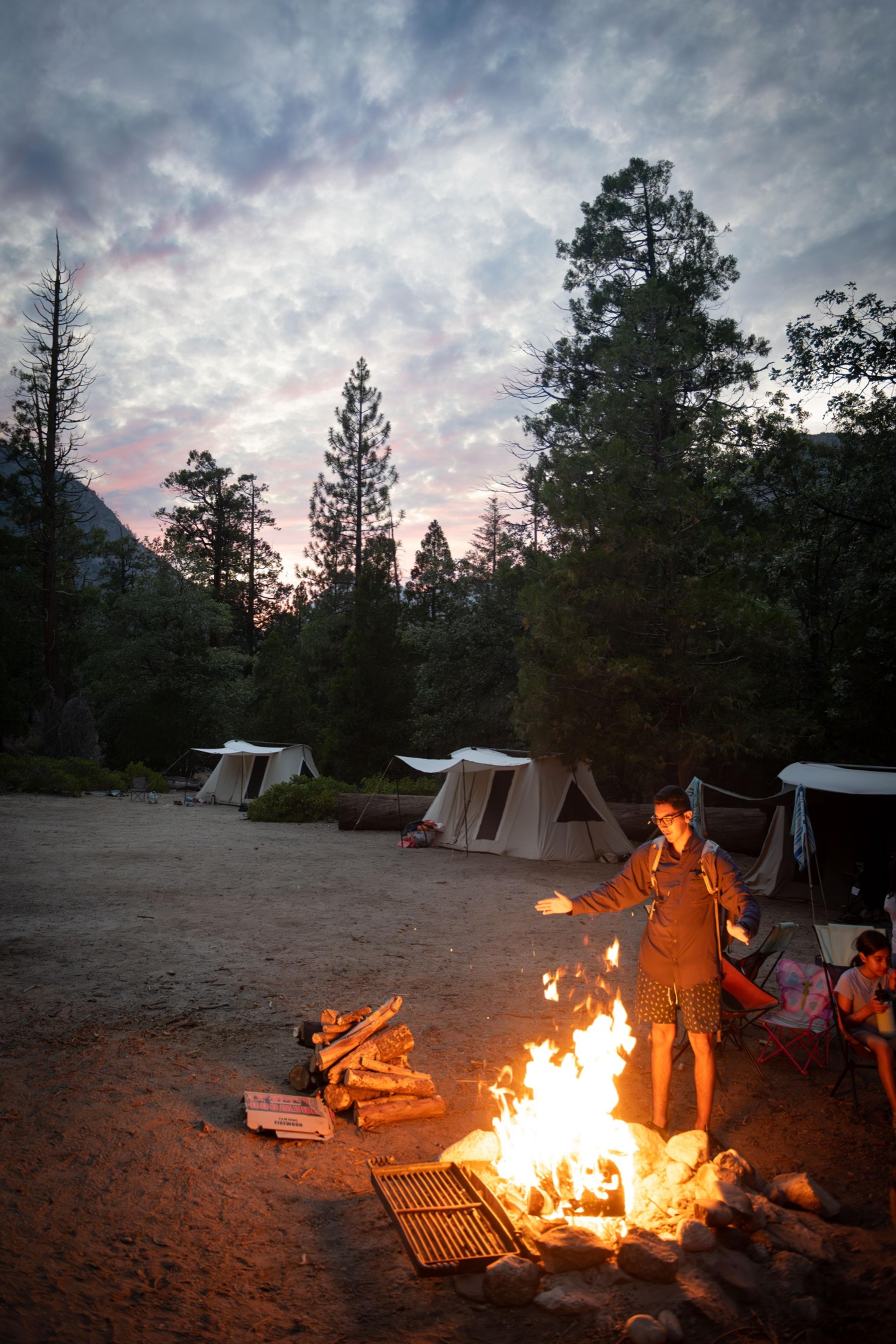
Kings Canyon, this July. Dusk fire duty.
Camp as it comes. Sometimes the camp is wet.
Putting it out properly
This is the part most guides cover in one sentence. It deserves five.
Stop adding wood at least 45 minutes before you want to go to bed. The fire needs time to burn down to a manageable size.
Drown it. Pour water slowly over the entire fire. Listen for hissing. Hissing means heat. Keep pouring.
Stir the ashes with a stick. Buried embers can hold heat for hours under a layer of ash. Stirring exposes them so the water can reach them. Pour more water after stirring.
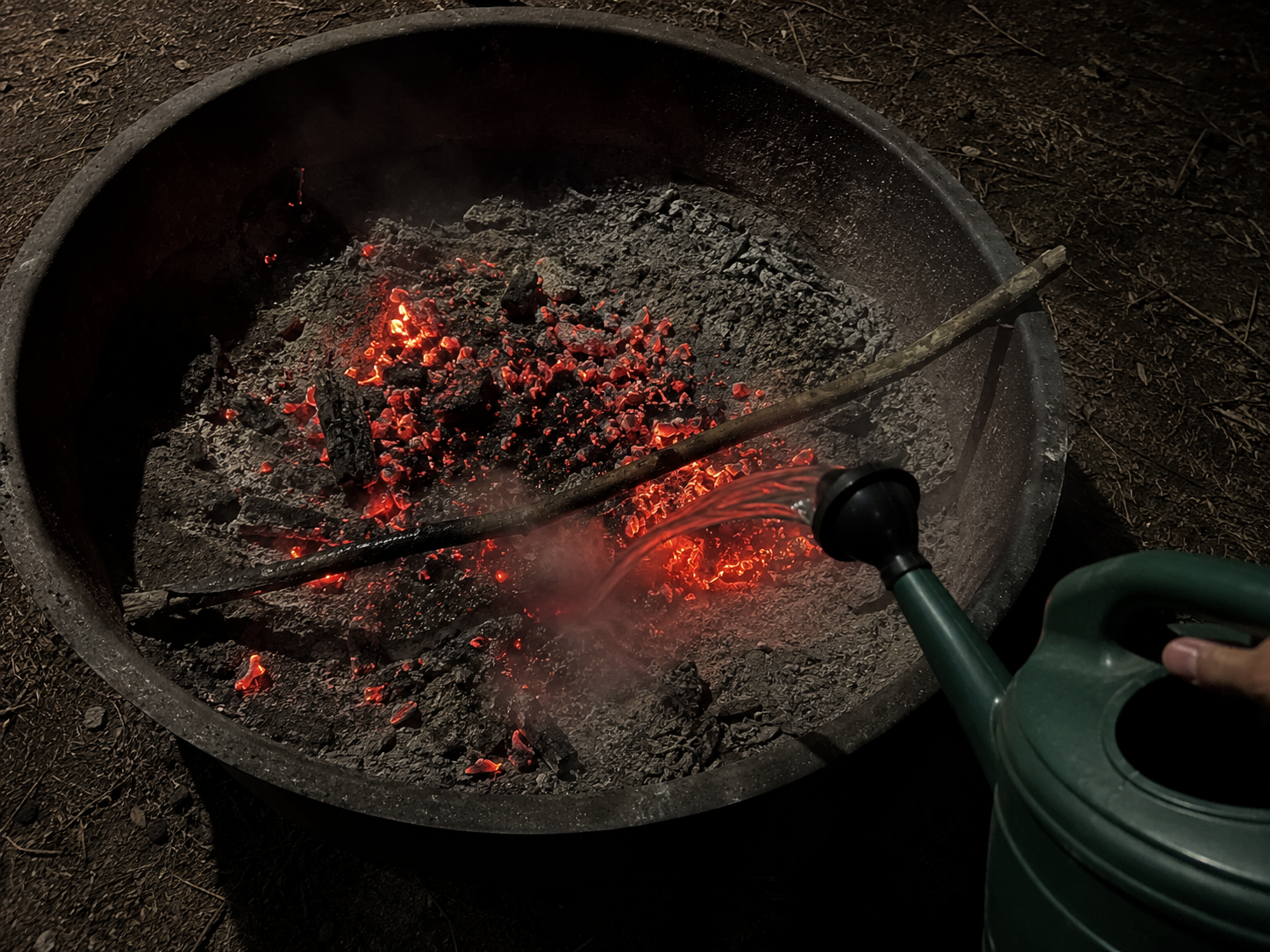
Hand test. Hover your hand a few inches above the ashes. If you feel any heat, it isn't out yet. Pour more water. Stir. Test again. Repeat until cold.
In bear country, this matters double. A warm fire pit holds food smells from dinner. We've had bears wander through campgrounds at 2 AM at Pinnacles and at Lake Alpine and in both cases the cold fire ring and locked bear box were why nothing came of it.
When fires aren't an option
Fire bans happen. Drought, high wind, regional declarations from CAL FIRE or the relevant National Forest. Sometimes propane is allowed when wood isn't, because propane has an off switch. The flame doesn't escape the way wood embers can.
We run two Outland Living 870 Premium fire pits on every group trip. They turn on with a knob, throw enough heat to circle, produce no smoke, and are usually allowed during regional fire bans when wood fires aren't. Each one runs about three hours on a standard 20-pound propane tank. We bring two so the kids' fire and the adults' fire can be at separate picnic tables, which is how we ended up with 30 people around the propane fires the night John lit his teepee.
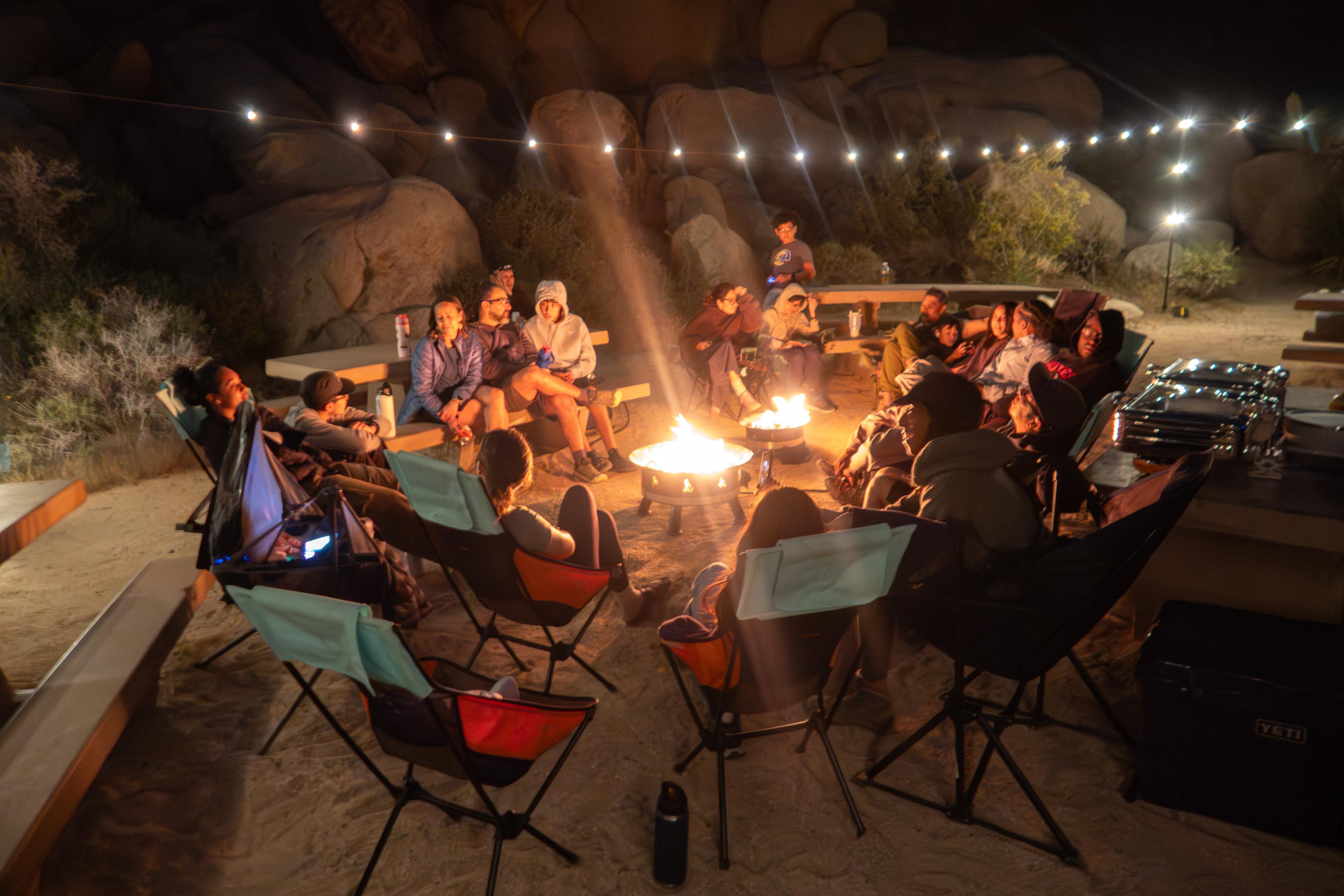
Propane fires can't roast a marshmallow the same way. The flame is too clean. You can hold a hot dog over them and it works, but real wood gives food a smoke flavor that propane never matches. We use propane when we have to and wood when we can.
Both are better than no fire at all. The fire is the gathering point. The fire is why people stay outside after dinner instead of going to bed.
What the fire is actually for
John taught his kids to build that fire at Williams Grove. By the end of the weekend, they were foraging downed branches on their own and bringing them to the pit, sorting them by size like they'd watched their dad do.
Eliza was three. She doesn't remember the trip clearly. She remembers Uncle John, his real fire, walking past the propane pits to find it. She remembers his two sons and his daughter. Some of those kids are now her friends through the group, four years later, and they all know each other from campgrounds and dinners and the fires their dads built.
A campfire heats food. It dries wet clothes. It keeps mosquitoes a little farther away.
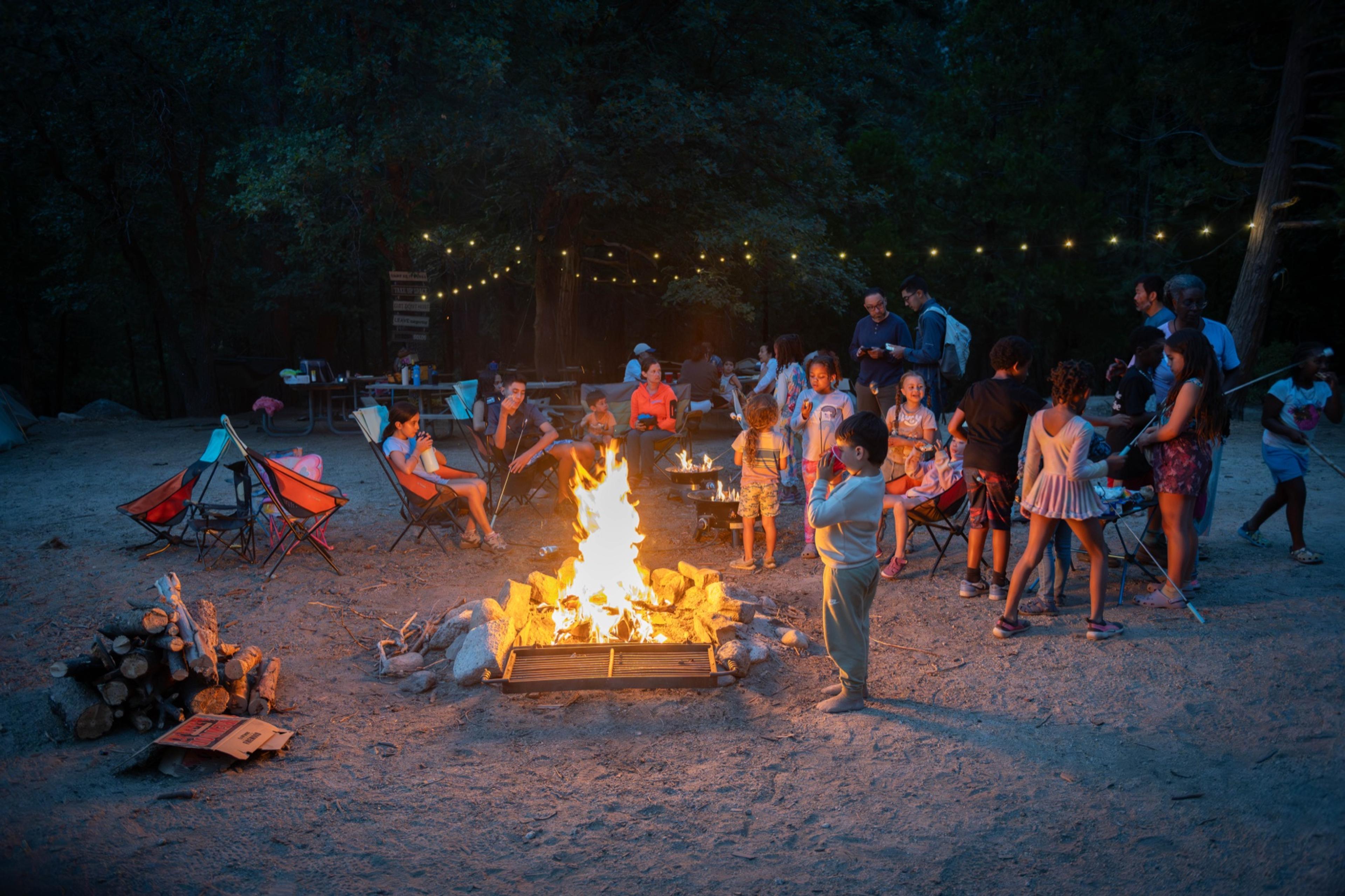
Kings Canyon, this July. The circle finds the fire every time.
It does other things too.
It's where the conversation actually happens. It's where a three-year-old will choose to walk toward an adult she's known for one day, because adults around a real fire are different than adults at a kitchen table. It's where the cousins decide who they're going to be friends with for the next decade. It's where you remember why you packed the car at 4 AM.
Build it well. Put it out completely. Sit around it long enough that the kids forget there's anywhere else to be.
Before you go
Check your campground's fire status before you leave. Make sure local firewood is allowed. Stack your tinder, kindling, and firewood in separate piles before you light a match. And bring a long lighter. The Exotac titanLIGHT or any wind-resistant long-neck. Stovetop matches are not enough.
For everything else, see our tent setup guide and complete camping checklist. Find your next group site on Camp Sage. Williams Grove is one of our favorites for big groups. The fires there have lit a lot of friendships.

Want a personalized version of this guide?
Camp Sage tailors recommendations to your dates, group, and gear — free.