The North Face Wawona 6
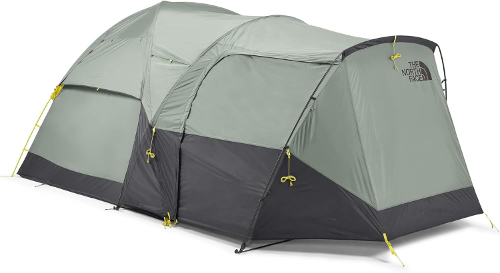
In about 10-15 minutes with a partner (15 solo), you will have a roomy 6-person tent with a massive vestibule for chairs, bikes, or gear.
With Partner
10-15 minutes
Solo
15 minutes
Capacity
Sleeps 6 | Peak height 6'6"
Vestibule
Adds 45 sq ft of covered space
Front door is mesh-only under the vestibule; back door has an arched double layer with pockets.
Photo of fully assembled Wawona 6 with vestibule extended
Orientation
Before you begin
Clear the pad, lay out your parts, and spot the color coding so setup flows smoothly.
Choose your spot
Find a flat 14 ft x 10 ft area. Clear rocks and sticks. Plan for the vestibule length in front.
Photo of cleared campsite with tent bag for scale
Unpack and verify parts
Lay everything out before you start so nothing is missing mid-setup.
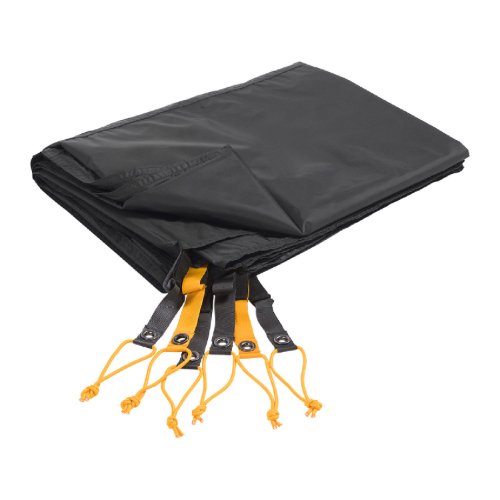
- Ground sheet / footprint (goes under tent - includes doormat flap)
- Tent body (mesh + floor)
- 2 YELLOW/ORANGE poles (identical main X)
- 2 GRAY poles: 1 straight pole (above front door) + 1 curved pole (vestibule arch)
- Rain fly with built-in vestibule
- Stakes
- Guy lines (for windy conditions)
Photo of all tent parts laid out and labeled
Key pole identification
One gray/black pole is straight (front door). The other has two curved bends (vestibule). Spot them early to avoid confusion.
Know your doors
Front door: single mesh layer under the vestibule with no pockets. Back door: arched, double-layered with equipment pockets that opens directly outside.
main body
Part 1: Main Tent Body
Raise the structure quickly and lock in the dome shape.
Lay out the ground sheet
Lay out the ground sheet
Place the ground sheet (footprint) on your cleared campsite. This protects the tent floor and defines exactly where your tent will sit. Orient the ground sheet so the 'doormat' flap extends toward the front - this flap goes under the vestibule area where you'll enter the tent, protecting the floor from dirty shoes and gear.
Doormat flap orientation
The ground sheet has an extended flap on one side - this is the 'doormat' that goes under your vestibule. Position it toward the front door so you have a clean surface under the vestibule entrance.
Photo of ground sheet laid flat with doormat flap visible
Lay out the tent body
Lay out the tent body
Spread the tent body with the floor down and mesh up. Face the mesh-only front door toward the vestibule area; the arched door marks the back.
Photo of tent body spread flat showing both doors
Assemble the yellow/orange poles
Assemble the yellow/orange poles
Snap the two identical yellow/orange poles together. Ensure every joint clicks securely.
Close-up of pole sections being connected
Thread yellow poles through sleeves
Thread yellow poles through sleeves
Follow the X-shaped YELLOW/ORANGE sleeves across the tent top and thread each pole corner-to-corner.
Solo setup tip
If alone, insert both poles into sleeves before seating pole ends. It is much easier to raise the dome this way.
Photo showing both yellow poles threaded in an X pattern
Secure yellow poles to corner grommets and raise the dome
Secure yellow poles to corner grommets and raise the dome
Insert pole ends into the corner grommets so the poles bend and the dome stands up. Each pole end goes through TWO grommets: the tent's grommet AND the grommet on the ground sheet beneath it.
- Have a partner hold one pole end in its grommets while you bend and insert the opposite end.
- Make sure the pole goes through both the tent's grommet AND the ground sheet grommet.
- Insert all four ends of one pole first, then the second pole.
- Start with the bottom-crossing pole so the top pole is easier to seat.
Common mistake to avoid
Seat the bottom pole first. Doing the top one first makes the second pole much harder to secure.
Close-up of pole end being inserted into corner grommet
Photo showing yellow poles upright with dome forming
Attach the clips
Attach the clips
Snap all plastic clips from the tent body onto the yellow poles to tension the walls.
Close-up of plastic clip snapping onto a pole
Add the front door pole (straight gray pole)
Add the front door pole (straight gray pole)
Thread the straight gray pole through the gray sleeve above the front mesh door. Important: The gray pole goes UNDER the yellow pole where they cross. Seat the pole ends into BOTH grommets at each corner - the tent's grommet AND the orange grommet on the ground sheet (which has an orange loop attached). This lifts the front wall to full height.
Important detail
The gray pole must go UNDER the yellow pole, not over. And make sure the pole ends go through both the tent grommet AND the orange ground sheet grommet with the orange loop.
Photo showing straight gray pole above front door
Photo showing gray pole going under yellow pole
Close-up of gray pole end in tent and orange ground sheet grommet
rain fly
Part 2: Rain Fly & Vestibule
The oversized vestibule is the star-45 sq ft of covered living space. Note: the fly does not cover the back door by design; the back door has its own rain layer.
Identify the front of the rain fly
Identify the front of the rain fly
Both the front and back of the rain fly have 'THE NORTH FACE' logos, so you can't use the logo to identify the front. Instead, look for the GRAY SLEEVE above the logo - this is the vestibule pole sleeve and marks the FRONT of the fly. The back side has a logo but no gray sleeve above it.
Front vs. back identification
Both sides have North Face logos! Look for the gray sleeve running above one logo - that's the front. The back logo has no sleeve above it.
Photo of rain fly showing gray sleeve above logo on front side
Drape fly over tent and attach back first
Drape fly over tent and attach back first
Drape the fly with zippers over the front door. Start at the back: thread the fly toggles through the rings above the back door corners.
Toggle tip
Push the toggle through, then rotate it 90 degrees so it catches. It gets easier with practice.
Close-up of toggle being threaded through back-corner ring
Attach velcro straps to poles
Attach velcro straps to poles
Wrap all velcro loops on the underside of the fly (including the center strap) around the poles to stop flapping and keep alignment.
Photo of velcro strap wrapped around tent pole
Insert the curved vestibule pole
Insert the curved vestibule pole
Thread the curved gray pole through the front fly sleeve. Important: When seating the pole ends, insert them into the grommet that has the STRETCHY STRAP running across the front of the vestibule - NOT the other nearby grommets. This strap helps tension and stabilize the vestibule arch properly.
Choose the right grommet
There are multiple grommets near each vestibule pole end. Use the one with the stretchy strap attached - this is critical for proper vestibule tension and shape.
Photo showing curved vestibule pole inserted in sleeve
Close-up of vestibule pole end in grommet with stretchy strap
Stake the webbing grommet first
Stake the webbing grommet first
Before staking the corners, find the grommet with the WEBBING STRAP attached - this is located between the tent body and vestibule. Stake this grommet first to anchor the vestibule to the tent structure. Pull it taut at a 45-degree angle away from the tent.
Why webbing grommet first?
Staking this grommet first anchors the vestibule to the tent body and creates proper tension for the rest of the staking sequence.
Photo showing webbing grommet being staked
Stake the front yellow straps
Stake the front yellow straps
Now stake the two YELLOW STRAPS at the front of the vestibule. Pull the vestibule forward to its full extension and stake these straps at 45-degree angles to create the vestibule's front corners.
Photo showing front yellow strap being staked
Connect gray clips to vestibule
Connect gray clips to vestibule
Find the small gray clips on the vestibule fabric and snap them onto the vestibule pole. This tensions the vestibule roof and keeps the fabric from sagging or flapping.
Photo showing gray clip connecting to vestibule pole
Attach vestibule grommets under tent corner grommets
Attach vestibule grommets under tent corner grommets
At each front corner of the tent, there are vestibule grommets that need to be attached UNDER the tent's corner grommets. Slip the vestibule grommet onto the same stake as the tent corner grommet, with the vestibule grommet on the bottom (closer to the ground). This creates a secure, layered connection.
Grommet order matters
The vestibule grommet goes UNDER (below) the tent corner grommet on the stake. This prevents the vestibule from pulling away from the tent.
Photo showing vestibule grommet under tent corner grommet on stake
Stake remaining tent corners
Stake remaining tent corners
Stake all four tent corners at a 45-degree angle away from the tent. The vestibule front corners should already be staked from step 13. Ensure all stakes are driven at an angle for maximum holding power.
Photo of stake driven at tent corner
Add guy lines (optional - for high winds)
Add guy lines (optional - for high winds)
If you expect windy conditions, attach the included guy lines to the loops on the rain fly and stake them out at 45-degree angles away from the tent. The guy lines add significant stability in gusty weather but are not necessary in calm conditions.
When to use guy lines
Guy lines are optional in calm weather but highly recommended if wind is expected. They prevent the fly from flapping and add structure stability.
Photo showing guy line attached to fly loop and staked
Stake the doormat flap
Stake the doormat flap
Finally, stake down the doormat flap of the ground sheet with two stakes at its front corners. This keeps the doormat flat and secure under the vestibule entrance, giving you a clean surface to step on when entering the tent.
Doormat purpose
The staked doormat keeps the vestibule floor clean and prevents the ground sheet from sliding around when you enter and exit the tent.
Photo showing doormat flap staked at front corners
Final checks
Walk the perimeter once and confirm these items before moving in.
- Ground sheet is flat with doormat flap extending under vestibule area
- All pole ends fully seated through BOTH tent grommets AND ground sheet grommets
- Gray front door pole goes UNDER yellow poles where they cross
- All clips attached to poles (tent body and vestibule)
- Rain fly oriented correctly (gray sleeve above logo = front)
- Velcro straps wrapped around poles
- Vestibule pole ends in grommets WITH stretchy strap
- Webbing grommet staked first
- Front yellow straps staked
- Gray vestibule clips attached to vestibule pole
- Vestibule grommets UNDER tent corner grommets on same stakes
- All four tent corners staked at 45-degree angles
- Doormat flap staked with two stakes at front corners
- Guy lines attached if windy conditions expected
- Zippers move smoothly
Congratulations!
Your Wawona 6 is ready for adventure!
Gear in This Guide
The other products you saw in this setup.
Setup Video
Watch a walkthrough of the full setup process.
Features
Rolling windows
Unzip and roll the large side windows. Fold the angled end first, then roll and secure with the loop and toggle. The back door's outer layer can roll up too.
Photo of side window rolled up and toggled
Vestibule doors
Both vestibule sides unzip and roll open. Secure with toggles for a breezy shaded hangout space.
Photo of vestibule with both doors rolled open
Quick reference
Width
8 ft (2.44 m)
Length
9 ft 6 in (2.9 m)
Peak height
6 ft 6 in
Floor area
85 sq ft
Vestibule
Adds ~75 in length, ~45 sq ft
Interior features
Wall and door pockets, 5 ceiling loops, vestibule gear loops, tension strap across vestibule.
Troubleshooting
I cannot tell the gray poles apart
Lay them flat. The vestibule pole has two clear bends creating an arch; the front-door pole is essentially straight with a slight curve.
I cannot tell which side of the rain fly is the front
Both sides have North Face logos! Look for the GRAY SLEEVE running above one logo - that's the front. The back logo has no sleeve above it.
The rain fly looks off-center
Align the fly so the gray sleeve is over the front door, adjust back toggle connections, then re-wrap velcro straps.
The vestibule sags or wrinkles
Make sure the gray clips are attached to the vestibule pole, and ensure the vestibule grommets are properly staked UNDER the tent corner grommets. If still sagging, add guy lines.
Which grommets do the vestibule pole ends go into?
Use the grommets that have the STRETCHY STRAP running across the front of the vestibule. Not the closest grommets to the tent body.
The toggles are hard to use
Push the toggle fully through the ring, then rotate 90 degrees so it catches. One hand on the toggle and one stabilizing the ring helps.
The back door seems exposed
That is intentional. The back door has a built-in double layer (mesh + rain cover) and does not need the fly.
Setting up solo is difficult
Insert both yellow poles into sleeves before seating ends, and when securing poles use the bottom-crossing pole first, then the top.
I forgot the ground sheet
You can still set up without it, but the tent floor is more vulnerable to punctures and moisture. Consider using a tarp if available, or be extra careful clearing the ground.