Springbar Leisure Port
A 140 sq ft canvas glamping shelter with swappable side panels. Pitch it open as a sunshade, zip the canvas walls on for a screen-house feel, or extend one side as an awning. About 20 minutes to set up. The trick is staking it out exactly to the footprint.
Setup Time
15-20 minutes
People Needed
1-2
Floor Area
10' x 14' (140 sq ft)
Peak Height
6.5 ft
Designed to pair with a Springbar Classic Jack 140 or stand alone. Same canvas, same frame system, no floor.
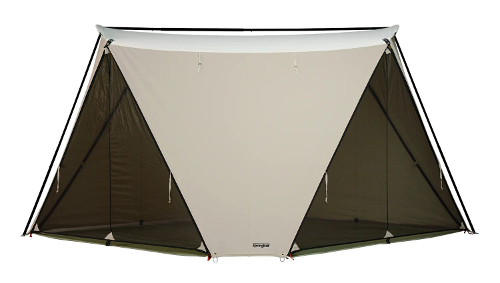
Photo of fully assembled Springbar Leisure Port with one side extended as an awning
Orientation
Before you begin
Clear the pad, lay out your parts, and spot the color coding so setup flows smoothly.
Choose your spot
Choose a flat, level area at least 12' x 16' to fit the 10' x 14' footprint plus stake-out room. Clear rocks, sticks, and roots. Critical: the Leisure Port must be staked exactly to its footprint — the frame won't tension properly otherwise. Don't try to pitch it over a picnic table unless you've laid a ground sheet first to mark the footprint.
Photo of the cleared, level site with footprint marked
Unpack and verify parts
Lay everything out before you start so nothing is missing mid-setup.
- Shelter body with integrated roof and side-panel zippers
- Ground sheet (sage green, sized to footprint)
- Two large T-connector poles (with T-fittings at the top)
- Two crossbar poles (push into the T-connectors)
- Two awning support poles (for extending one side as an awning)
- Six metal ground hooks (4 corners + 2 sides — double on awning side)
- Plated steel nail stakes (around 14 needed)
- Two tension straps
- Two mesh side panels (zip-in)
- Two solid canvas side panels (zip-in)
- Owner's field guide and carry bags
Photo of all Leisure Port parts laid out on the ground sheet
Footprint accuracy is everything
Unlike a regular tent, the Leisure Port won't forgive a sloppy stake-out. The frame relies on each stake landing in exactly the right spot for the canvas to tension. Either lay the ground sheet first and stake to its corners, or measure twice. We've seen first-time setups go sideways more than once because someone winged the stake positions.
What we use it for
Three of our favorite Leisure Port configurations from group trips: (1) Hang a white sheet inside with one side open as an awning — outdoor movie theater for the kids. (2) Open one side as an awning, place a propane fire pit inside — the canvas reflects heat without trapping it. (3) Zip all four canvas panels closed as a private changing room or kid nap shelter on a hot beach day.
setup
Part 1: Frame Setup
Lay the ground sheet, spread the shelter body, attach the ground hooks, drive the stakes, then build the frame from the crossbars up.
Unpack and lay out all components
Unpack and lay out all components
Grab the Leisure Port bag and the separate pole bag. Lay both bags on the ground at your site and pull everything out. Identify each component before you start: shelter body, ground sheet, two T-connector poles (with T-fittings on top), two crossbars, two awning support poles, six ground hooks, stakes, tension straps, and the side panels.
Photo of all components laid out and identified
Lay out the ground sheet on a flat surface
Lay out the ground sheet on a flat surface
Unfold the ground sheet completely and spread it flat on your prepared site. The ground sheet protects the shelter floor area from moisture and abrasion and also gives you a perfect outline of the footprint, which makes the next steps far easier.
Photo of ground sheet laid flat on site
Lay the shelter on top of the ground sheet
Lay the shelter on top of the ground sheet
Lay out the tent on top of the ground sheet. Line it up so the double webbing loops are where the double metal hooks are, and the single hooks along the edges are where the single hooks are. The double-loop side will become your awning side if you choose to extend one. The other three sides have single loops.
Photo of shelter body spread on ground sheet, oriented
Hook the metal hooks into the webbing loops
Hook the metal hooks into the webbing loops
Connect all six metal ground hooks into the nylon webbing loops on the shelter body. Two doubles on the awning side, plus singles on the other three sides — six total. The hooks are what your stakes will drive through.
Close-up of ground hook attached to webbing loop
Stake the six ground-hook loops
Stake the six ground-hook loops
Pound the stakes through all six ground-hook loops. Angle each stake away from the tent at 45 degrees. Stake the corners first to set the square, then the side loops. The rectangle must be square or the frame won't tension properly when you raise it.
Don't shortcut the corners
If the rectangle isn't square, the frame won't tension and you'll fight the canvas for the rest of the setup. Stake conservatively at first, then refine after the frame is up.
Close-up of corner stake driven through ground hook
Lay out the two T-connector poles
Lay out the two T-connector poles
Lay out the two large T-connector poles alongside the shelter. There should be one T-connector facing up on each side of the tent. That's where the smaller crossbars will push in next.
Photo of T-connector poles laid out alongside the shelter
Thread the crossbars through the roof sleeves
Thread the crossbars through the roof sleeves
Thread the two smaller crossbars through their fabric sleeves along the roof. Push each crossbar in with the rubber side facing out so the end of the pole won't snag the sleeve or scratch the fabric.
Photo of crossbar pole being threaded through roof sleeve
Push the crossbars into the T-connectors
Push the crossbars into the T-connectors
Push the small crossbar ends into the T-connector at each side of the shelter. The T-fittings hold the crossbars in place at the peak of the roof. Repeat on the other side so both ends of both crossbars are seated.
Photo of T-connector fitting onto crossbar at one end of shelter
Connect the two middle crossbars and create tension
Connect the two middle crossbars and create tension
Push the two middle crossbars together at the center. The end with the rounded-out bolt aligns with the end with the rounded-in concave. Push the pieces together until they engage, then press down so there's tension on the poles.
What good tension feels like
The center joint should sit flat and straight once both halves engage. If it bows or wobbles, the corners weren't staked tightly enough — re-stake before you raise the frame.
Photo of two middle crossbars being pushed together with bolt and concave aligned
Slide the slip cover over the center joint
Slide the slip cover over the center joint
Once both crossbars are pushed together and tensioned, the joint should be nice, flat, and straight. Pull the slip cover (a fabric sleeve already on the pole) over the center joint to lock the two halves in place.
Photo of crossbar poles fully tensioned, slip cover ready to slide over center joint
Verify the slip cover sits over the joint
Verify the slip cover sits over the joint
Double-check the slip cover is fully seated over the center joint. The cover should completely hide the seam between the two crossbar halves. If it doesn't reach, push the two halves a touch closer together.
Close-up of center slip cover positioned over the crossbar joint
Assemble the two long upright poles
Assemble the two long upright poles
Grab the two long upright poles and put each one together. Set the height by aligning the spring button with one of the holes near the top of the pole. You want the pole fairly tall but not all the way to maximum — the frame works best with a click or two of headroom to spare.
Photo of two long upright poles connected with button near top of holes
Insert one upright into the T-connector grommet
Insert one upright into the T-connector grommet
Insert the first upright pole into the grommet on the underside of the T-fitting at one end of the main top support bar. Do this one side at a time. Once seated, press the bar all the way up to a vertical position. The canvas will rise with it.
Photo of upright pole being inserted into grommet on underside of T-connector
Verify the first upright is fully raised
Verify the first upright is fully raised
Check the first upright is locked vertical and stable along the edge of the shelter. The crossbar above it should be horizontal, the canvas should be tensioning, and the pole should sit flush against the grommet without slipping.
Photo of one upright fully raised showing vertical rise on the edge of the shelter
Raise the second upright and lock the frame
Raise the second upright and lock the frame
Repeat step 13 on the opposite end. Once both uprights are in and locked, the frame is up and the shelter holds its shape. The roof should be drum-flat. Walk around and check that no canvas is wrinkled or pooling — wrinkles mean the upright is set too short; straining canvas means the corners weren't staked accurately.
Photo of shelter frame raised with both T-connectors at peak
panels
Part 2: Side Panels (Optional)
The four zippered side openings can stay open, or you can install mesh panels for bug-free shade, or canvas panels for full enclosure.
Choose your panel configuration
Choose your panel configuration
You have multiple options for what side panels to install: two mesh panels, two canvas panels, all four, or none. Mix and match: all canvas for privacy and weather, all mesh for bugs-out airflow, or two and two for partial enclosure.
Photo showing the four panel options laid out (2 mesh + 2 canvas)
Zip in your chosen panels
Zip in your chosen panels
Each panel zips into the shelter from inside. Run the zipper from one corner across the top and down the other side. The panels stake out at the bottom — re-stake through the panel loop to lock it in place. Here's what it looks like with two open sides and two mesh panels installed.
Photo of shelter with two open sides and two mesh side panels installed
awning
Part 3: Awning Extension (Optional)
Lift one side of the shelter into an extended awning using the two adjustable support poles. Creates a covered outdoor space over a picnic table, propane fire, or movie-night setup.
Get the two awning support poles ready
Get the two awning support poles ready
You have the option of lifting one side of the shelter using the two awning support poles. Grab them and bring them to the side you want to lift — usually the double-loop side. Set their height with the pin button so the lifted edge will sit roughly at peak height.
Photo of the two awning support poles ready to lift up one side of the shelter
Lift the side with the support poles and stake the guy lines
Lift the side with the support poles and stake the guy lines
Lift one side of the shelter upward with each support pole. Connect the pole to the edge of the shelter at the corner. Run a guy line from each pole's top out at a 45-degree angle and stake the guy line firmly. The lifted side now acts like a ceiling over your awning space.
Our favorite awning configuration
Put a propane fire pit just inside the awning entrance. The canvas reflects heat back toward the seating area without trapping smoke. Keep one side open for ventilation and never use this configuration in heavy wind.
Photo of awning extended with guy lines staked
Verify the awning connector hooks
Verify the awning connector hooks
Check the close-up details: the support pole top sits in the grommet at the lifted edge, and the red hook connector along the edge engages where the support pole attaches. Both should be firmly seated. If the red hook isn't engaged, the awning will drop the moment a wind gust hits.
Close-up of red hook connector on the edge where the awning support pole attaches
Final assembly check
Final assembly check
Stand back and look at the whole setup. The Leisure Port should be square, the roof taut, the lifted awning angled slightly downward for water runoff, and all guy lines tensioned. You're done.
Photo of fully assembled Springbar Leisure Port with one side extended as an awning
teardown
Part 4: Pack-Up
Tear down in reverse order. Critical: the canvas must be bone dry before packing or mildew will set in.
Remove the awning poles and side panels
Remove the awning poles and side panels
If the awning is extended, lower it first by removing the support poles and unstaking the tension straps. Then unzip and remove any installed mesh or canvas side panels.
Lower the frame
Lower the frame
Disengage the upright poles by depressing the pin buttons. Lower the frame gently, supporting one end at a time to avoid stressing the fabric or bending the poles.
Disconnect and remove the poles
Disconnect and remove the poles
Slide back the center slip cover and separate the crossbars. Remove the crossbars from the T-connectors and slide them out of the fabric sleeves. Collapse all poles and store in the pole bag.
Remove stakes, fold, and pack
Remove stakes, fold, and pack
Pull all stakes and unhook the ground hooks from the webbing loops. Brush off any dirt or debris. Fold the shelter neatly from the edges toward the center, then roll tightly. Verify the canvas is completely dry before packing — if it's even damp, set it up at home to dry before storage.
Wet canvas grows mildew
Never store the Leisure Port packed wet. We've laid ours out across the garage floor with a dehumidifier running when we couldn't dry it at the campground. Worth the extra hour to avoid mildew that's hard to remove.
Final checks
Walk the perimeter once and confirm these items before moving in.
- All six ground hooks are connected to their webbing loops and staked at 45 degrees
- Corners are square (diagonals match) and stakes are secure
- Both T-connectors are seated firmly on the crossbars at the peak
- Slip cover is positioned fully over the center crossbar joint
- Both upright poles are pinned at the right height and the canvas is taut
- Side panels (if installed) are zipped fully and staked through the bottom loop
- Awning poles (if extended) are pitched downward for rain runoff and guyed at 45 degrees
- Red hook connectors are engaged where the awning support poles attach
Congratulations!
Your Leisure Port is up. Open it as a sunshade, close it as a screen house, or extend one side as an awning over a picnic table or propane fire. We've used ours for outdoor movie nights with the kids and as a heated cocktail lounge on cold high-desert evenings. Most flexible canvas shelter in the camp.
Features
Modular Side Panels
Two mesh and two canvas zip-in panels let you build the shelter you need for the day — full enclosure, full ventilation, or anything in between. Panels swap in five minutes once the frame is up.
Extendable Awning Configuration
One side converts to a covered awning using the two adjustable upright poles. Nearly doubles your shaded area. Great for outdoor kitchens, dining setups, or sheltering a propane fire pit.
Springbar Tension Frame
T-connector + crossbar + slip-cover joint system. Same tension frame architecture as Springbar's Classic Jack tents. Creates a taut, wind-resistant structure that holds its shape without constant adjustment.
Same Canvas as the Classic Jack
8.5 oz HardyDuck cotton walls, treated for water resistance. Breathes naturally, blocks UV, and reflects heat. Pairs visually and functionally with a Classic Jack 140 tent.
Quick reference
Floor Area
10' x 14' (140 sq ft, no floor)
Peak Height
6.5 ft
Total Weight
~55 lbs (shelter 26 lbs + poles 25 lbs + stakes 4 lbs)
Canvas
HardyDuck cotton (8.5 oz walls)
Frame
EP-coated steel
Stakes Included
Plated steel nail stakes (~14)
Poles
2 T-connector + 2 crossbar + 2 awning extension
Side Panels
2 mesh + 2 canvas (zip-in, included)
MSRP
$699 (Dune or OD Green)
Manufacturer
Springbar (springbar.com)
Troubleshooting
The canvas is sagging and won't tension
Your corner stakes aren't placed exactly to footprint. The frame relies on the canvas being staked to its dimensions. Re-stake the corners until the rectangle is square (diagonals match), then re-tension the frame.
The T-connectors won't seat on the crossbars
The crossbars aren't fully inserted into the fabric sleeves, or the upright pole is too short. Push each crossbar all the way through its sleeve, then extend the upright pole one click at a time until the T-connector seats.
The center joint between the two crossbars won't engage
The bolt end and the concave end need to align before they push together. Rotate one of the crossbars 90 degrees if they aren't lining up. Push down firmly once aligned, then slide the slip cover over the joint to lock it.
The awning is collecting water in the middle
The awning isn't pitched downward enough. Shorten the inner upright poles or lengthen the outer awning support poles until the awning slopes from inside to outside. Water should run off the front edge.
Can I pitch it without the ground sheet?
Yes — the Leisure Port has no integrated floor, so the ground sheet is optional. We always use it because it marks the footprint for easier corner staking, but it isn't required for the frame to work.
Can I leave the canvas panels off and just use mesh?
Yes. Mix and match in any combination. Two mesh + two canvas is our default for windy or sunny conditions. All mesh works in summer evenings when you want airflow and bug protection. All canvas works for changing rooms or storage.
Can I use a propane fire pit inside?
With caution: only when one side is fully open as an awning, and never in heavy wind. The canvas reflects heat well but the shelter is not stove-rated. Maintain clear ventilation, keep the fire pit away from the canvas walls, and never leave it unattended.
It smells musty after storage
The canvas was packed damp. Set up the shelter in direct sunlight for a full day to dry. For active mildew, use a mildew-specific canvas cleaner per Springbar's care guide, then re-treat the affected area with a silicone-based water repellent.