Springbar Classic Jack 140
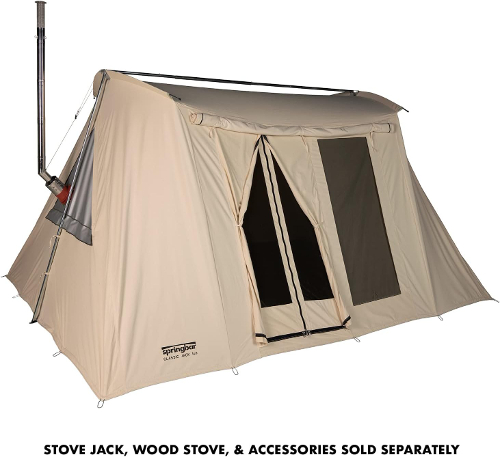
In about 20-30 minutes with a partner, you can pitch a 140 sq ft canvas glamping tent with a covered awning, standing headroom, and room for the whole crew. Setup is the same for the Classic Jack 100 (10x10).
With Partner
20-30 minutes
Solo
30-45 minutes
Floor Area
10' x 14' (140 sq ft)
Peak Height
6.5 feet
All poles are labeled. Upright poles measure 7 feet on the shortest setting. Awning poles are shorter and labeled 'Awning Pole'.
Photo of fully assembled Springbar Classic Jack 140 with awning extended
Orientation
Before you begin
Clear the pad, lay out your parts, and spot the color coding so setup flows smoothly.
Choose your spot
Select a dry, level site and clear rocks, sticks, and debris. You need roughly 14' x 20' of space to accommodate the tent footprint plus the front awning. Orient the tent so the front door and awning face the direction you want.
Photo of ground tarp laid out on cleared campsite
Unpack and verify parts
Lay everything out before you start so nothing is missing mid-setup.
- Tent and roll bag x 1
- Pole bag x 1 (contains all poles)
- Upright poles x 2 (labeled 'Upright Pole', 7 ft on shortest setting)
- Awning poles x 2 (labeled 'Awning Pole', shorter than uprights)
- Ridge pole (3-piece, connects with steel sleeve)
- Steel sleeve pole x 1
- Tension rods x 4
- Plated steel 12" nail stakes x 18
- Tension rope with tie guy x 2
- Lantern straps x 2
- Canvas tent stake bag
- Ground tarp x 1 (optional but recommended)
- Stormfly rain fly x 1 (optional, sold separately)
Photo of all poles laid out and labeled: upright, awning, ridge, tension rods
Poles are labeled
Every pole has a label printed on it: 'Upright Pole', 'Awning Pole', or 'Ridge Pole'. Check the labels before assembling to avoid mixing them up.
Shoes off on the canvas
Always remove your shoes before walking on the tent fabric. Boots and shoes can grind dirt into the canvas and damage the waterproof coating.
setup
Part 1: Tent Setup
Stake down the tent body, build the ridge, raise the uprights, and extend the awning.
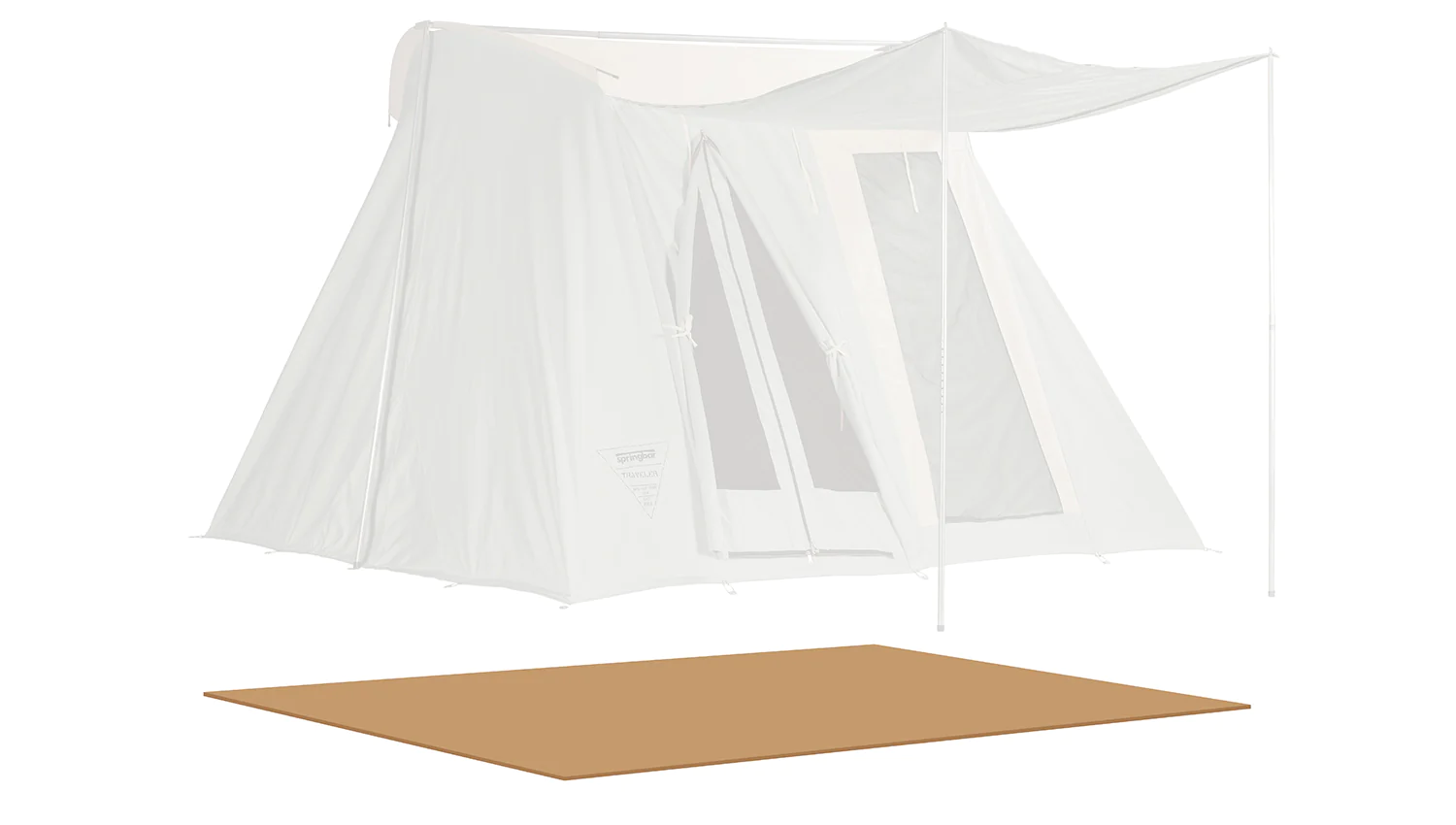
Lay down the ground tarp
Lay down the ground tarp
Select a level site and lay down your ground tarp to create a clean, dry, and protected base for your tent. Make sure the tarp is centered and lined up with the edges of your tent.
Photo of ground tarp laid flat on campsite
Stake down the tent
Stake down the tent
Lay the tent body flat on the ground tarp. Select a level site and keep the tent as 'square' as possible. Springbar tents must be securely staked down to function. When laying out the tent, ensure the awning and front door face your desired direction.
Stakes and ground tarp
Stakes do not need to go through the ground sheet. Stake through the tent's corner loops directly into the ground.
Photo of Springbar tent body staked flat on ground showing square layout
Photo of 18 plated steel 12 inch nail stakes laid out
Insert ridge poles and tension rods
Insert ridge poles and tension rods
Use the 3-piece ridge pole, 1 steel sleeve, and 4 tension rods. Thread the ridge poles through the ridge sleeve on the roof of the tent. Look for poles labeled 'Ridge Pole'.
Shoes off
Take off your shoes when walking on the tent fabric to insert the ridge poles.
Diagram showing ridge pole and tension rod placement on tent roof
Tension the roof panel
Tension the roof panel
Place the ridge poles end to end and press down to tension the roof. Slide the steel sleeve over the connection point to secure the ridge.
Adjustable tension
The tension screw may be adjusted to achieve more or less tension as needed.
Photo of person pressing ridge poles to tension roof with steel sleeve
Position the rain fly (if using Stormfly)
Position the rain fly (if using Stormfly)
Lay the rain fly over the tent with the inside facing up. Position the zipper flap so the ridge pole rests in the middle. The zipper flap is designed to be on the underside of the rain fly.
Photo of rain fly draped over tent with zipper flap visible
Loop the rain fly around the ridge poles
Loop the rain fly around the ridge poles
Wrap the toggle/loop around one end of the ridge pole and pull it snug. Repeat for the other end.
Close-up of rain fly toggle being wrapped around ridge pole end
Zip up the rain fly flap across the ridge pole
Zip up the rain fly flap across the ridge pole
Zip up the flap all the way so the ridge pole is completely enclosed in it.
Photo of rain fly zipper being closed around ridge pole
Install one upright pole
Install one upright pole
Assemble the upright pole on the shortest setting. After installing, lengthen the pole until the walls are taut but not too tight. Make sure the tent door is unzipped to allow air to enter.
- Do not confuse an awning pole for an upright pole. Upright poles measure 7 feet on the shortest setting.
- Make sure the tent door is unzipped to allow air to enter while raising the pole.
- When adjusting upright pole length, move the base of the pole away from the tent to relax tension. After adjustment, move the base back into position over the stake loop.
Diagram of upright pole being installed with tips for length adjustment
Install second upright pole
Install second upright pole
Follow the same procedure outlined in step 8 for the second upright pole on the opposite end. Look for poles labeled 'Upright Pole'.
Diagram showing tent with both upright poles installed
Stake the Stormfly along the sides (if using)
Stake the Stormfly along the sides (if using)
Stake one end of the rain fly out about 18-36 inches from the bottom of the upright pole. Tighten the adjustable buckle snug. Repeat for the other end.
Close-up of Stormfly speed buckle strap attached to tent frame
Stake the rain fly along the front and back (if using)
Stake the rain fly along the front and back (if using)
Starting with the back of the tent, attach a hook red buckle strap through a corner web loop and stake it out at about a 45-degree angle, about 48 inches away from the tent corner. Repeat for the other corner and snug both tight. Repeat for the middle web loop as a more secure option.
Close-up of red buckle strap attached to rain fly corner web loop and staked
Stake out the awning poles
Stake out the awning poles
Roll up and secure the tent's canvas awning so it is out of the way (it is not needed when the rain fly is in use). Stretch out the rain fly awning panel with the black tension ropes and secure it with 2 awning poles guyed out (anchored). Look for poles labeled 'Awning Pole'.
Diagram of awning poles staked out at 45-degree angle with tension ropes
(Optional) Stake out the canvas awning
(Optional) Stake out the canvas awning
If you prefer to roll up the rain fly along the front and use the canvas awning instead, stretch out the tent's canvas awning panel and secure it with 2 awning poles guyed out (anchored) with the black tension ropes, one on each corner.
Diagram of fully assembled Springbar tent with awning poles and tie guys
(Optional) Install lantern strap inside tent
(Optional) Install lantern strap inside tent
Inside the tent, attach the lantern strap to the sewn rings along the top wall of the tent and tension it across the roof panel. Can be installed in an X from tent corners or as a single strap from end to end. Useful for hanging lighting, clothing, and other gear items.
Photo of lantern strap attached to ceiling junction inside tent
pack up
Part 2: Pack-Up Guide
Take down the tent in reverse order, store everything in its designated bag, and make sure the tent is dry before packing.
Store it dry, store it clean
Tents must be packed up DRY to avoid mold. If your tent is wet from dew or rain, dry it in the sun before packing. This goes for the poles too.
Sweep and vacuum
Sweep and vacuum
Clean out any accumulated dust and dirt from the tent. Wipe down any spills.
Illustration of hand vacuum cleaning inside tent floor
Remove the lantern strap (if used)
Remove the lantern strap (if used)
Store the lantern strap in the outside zipper pocket of the tent roll bag.
Photo of tent roll bag showing outside zipper pocket for lantern strap storage
Disassemble and roll up the awning
Disassemble and roll up the awning
Remove the two nail stakes and black ropes with wood tension blocks, remove the awning poles, and roll up the canvas awning. Store stakes and ropes in the canvas tent stake bag.
Photo of awning poles being removed with stakes and tension ropes visible
Remove the Stormfly stakes and speed buckle straps (if used)
Remove the Stormfly stakes and speed buckle straps (if used)
Pull up the stakes, remove the speed buckle straps (black straps with red buckles), and store them in the nylon Stormfly stake bag.
Photo of Stormfly stakes and speed buckle straps being stored in nylon bag
Disassemble the upright poles
Disassemble the upright poles
Remove each upright pole by collapsing it and pulling it free from the tent. Make sure the door is unzipped to allow air to quickly exit the tent.
Unzip the door first
Unzipping the tent door lets air escape quickly as the tent collapses, making pole removal much easier.
Diagram showing person removing upright pole from tent
Disassemble the ridge poles and tension rods
Disassemble the ridge poles and tension rods
Remove the steel sleeve, separate the ridge pole sections, and remove the tension rods. Remember to take off your shoes when walking on the tent.
Diagram showing ridge poles being disassembled with shoes-off reminder
Remove and store the Stormfly (if used)
Remove and store the Stormfly (if used)
Make sure all items including the rain fly, stake bag (nail stakes and speed buckle straps) are stored inside the Stormfly bag.
Photo of Stormfly rain fly and stake bag packed in nylon Stormfly bag
Store all the poles in the pole bag
Store all the poles in the pole bag
Confirm you have all the following poles stored in the pole bag: 2 upright poles, 2 awning poles, 3 ridge poles, 1 ridge sleeve, and 4 tension rods.
Diagram of pole bag contents showing all pole types labeled
Remove the stakes
Remove the stakes
Pull all 18 nail stakes from the ground. Store the stakes in the canvas tent stake bag. Place the stake bag in the tent roll bag.
Photo showing stakes being stored in canvas stake bag and placed in roll bag
Roll up and store the tent
Roll up and store the tent
Fold the tent up using the green straps to secure it. Make sure the tent is clean and dry before placing in the bag. Lay flat, fold once lengthwise, fold again (use tent bag as width guide), then roll tightly and strap.
- Step 1: Lay flat (10' x 14')
- Step 2: Fold lengthwise (fold corner to stake loop)
- Step 3: Fold again (lay tent carry bag at end to check width fits)
- Step 4: Roll tightly and secure with the green roll straps
Illustration of tent being folded in four steps: lay flat, fold, fold again, roll
Roll up and store the ground tarp
Roll up and store the ground tarp
Place the ground tarp in the ground tarp storage bag.
Photo of ground tarp being placed in its drawstring storage bag
tent layouts
Part 3: Interior Layout Options
Reference layouts for setting up cots, rugs, and chairs inside different tent sizes. These diagrams show how to arrange sleeping and living space based on your group size.
10x14 (XL) tent: 5-person layout
10x14 (XL) tent: 5-person layout
Two cots on one side with a queen air mattress, rug in the center, and one cot plus a single air mattress on the other side. Chair near the door.
Diagram of 10x14 (XL) tent layout with 4 sleeping bags, rug, and heater
10x14 (XL) tent: 4-person layout
10x14 (XL) tent: 4-person layout
One cot on the left with space, rug in center with chair, and two cots on the right side. More spacious living area in the middle.
Diagram of 10x14 (XL) tent layout with 4 cots, rug, and chair
10x14 (XL) tent: 3-person layout
10x14 (XL) tent: 3-person layout
Rug and two chairs on the left side with three individual cots on the right. Maximum living space with comfortable sleeping for three.
Floor plan diagram of 10x14 tent with 3-person layout
10x10 (L) tent: 3-person layout
10x10 (L) tent: 3-person layout
Three cots arranged side by side with a rug and chair at the foot. Efficient use of the square 100 sq ft floor plan.
Floor plan diagram of 10x10 tent with 3-person layout
10x10 (L) tent: 2-person layout
10x10 (L) tent: 2-person layout
Two cots spaced apart with a rug and chair between them. Generous personal space in a roomy square tent.
Floor plan diagram of 10x10 tent with 2-person layout
9x8 (M) tent: 2-person layout
9x8 (M) tent: 2-person layout
Two cots side by side with a rug between them. Cozy but comfortable in the medium tent.
Floor plan diagram of 9x8 tent with 2-person layout
9x8 (M) tent: 1-person layout
9x8 (M) tent: 1-person layout
One cot with a rug and chair. Plenty of room for one person with a comfortable living area.
Diagram of 9x8 (M) tent layout with 1 cot, rug, and chair
Final checks
Walk the perimeter once and confirm these items before moving in.
- All stakes are secure and the tent is taut
- Front door zips and unzips smoothly
- Awning is extended and guyed out with tension ropes
- Rain fly (if used) is zipped over the ridge and staked at corners
- Lantern strap is installed inside for hanging lights and gear
- Interior is set up with cots, rug, and chair per your layout
Congratulations!
Your Springbar Classic Jack 140 is ready. With 140 square feet of canvas, standing headroom, and a covered awning, you have a proper campsite base camp. Enjoy the space.
Gear in This Guide
The other products you saw in this setup.
Setup Video
Watch a walkthrough of the full setup process.
Features
HardyDuck Canvas
10 oz roof and 8.5 oz wall cotton canvas that breathes naturally, reducing condensation compared to synthetic tents. The canvas also provides excellent insulation in both hot and cold weather.
Built-In Canvas Awning
The integrated 6' x 6' canvas awning creates covered outdoor living space for cooking, hanging out, or escaping light rain without any extra tarps.
Springbar Tension System
The patented spring-loaded upright poles create a taut, wind-resistant structure. The tension screw lets you fine-tune the roof tension for any conditions.
Stormfly Rain Fly Compatibility
The optional Stormfly rain fly adds full waterproof and UV protection over the canvas, extending the tent's lifespan and keeping you dry in heavy rain.
Quick reference
Floor Area
10' x 14' (140 sq ft)
Peak Height
6.5 feet
Total Weight
~80 lbs (tent ~46 lbs + poles ~26 lbs)
Canvas
HardyDuck cotton (10 oz roof / 8.5 oz walls)
Stakes Included
18 plated steel 12" nail stakes
Poles
2 uprights, 2 awning, 3 ridge, 1 sleeve, 4 tension rods
Awning Size
~6' x 6' integrated canvas
Available Sizes
Classic Jack 140 (10x14), Classic Jack 100 (10x10)
MSRP
$1,299 (tent) / $198-$209 (Stormfly)
Manufacturer
Springbar (springbar.com)
Troubleshooting
The walls are saggy and not taut after raising the uprights
The upright poles need to be lengthened. Move the base of the upright away from the tent to relax tension, extend the pole one click, then reposition the base over the stake loop. Repeat until the walls are taut but not overly tight.
I can't tell the upright poles from the awning poles
Check the labels printed on each pole. Upright poles are labeled 'Upright Pole' and measure 7 feet on the shortest setting. Awning poles are shorter and labeled 'Awning Pole'.
The ridge poles won't stay connected
Make sure you are sliding the steel sleeve over the connection point after placing the ridge poles end to end. The sleeve locks them together. Check the tension screw for proper tension.
The tent is leaning to one side
The tent is not staked squarely. Re-stake the corners to form a true rectangle. Both upright poles should be the same length setting.
Rain is getting under the Stormfly
Make sure the Stormfly is staked out 18-36 inches from the uprights at the sides, and 48 inches at 45-degree angles at front and back. The buckle straps should be snug. Use the middle web loop for extra security.
The tent smells musty after storage
The tent was likely stored damp. Set it up in direct sunlight and let it dry completely. Canvas can develop mold if stored wet. Always ensure the tent is bone dry before packing.
I can't fit the tent back into the roll bag
Lay the tent carry bag on the ground next to the tent when folding to check the width. Fold to match the bag width, then roll tightly from one end. Use the green straps to compress the roll before sliding into the bag.
Stakes won't hold in soft or sandy soil
Drive stakes at a 45-degree angle away from the tent for better holding power. In very soft soil, you may need longer stakes or deadman anchors (bury a stick or rock with the guy line wrapped around it).