Kodiak Canvas Cabin
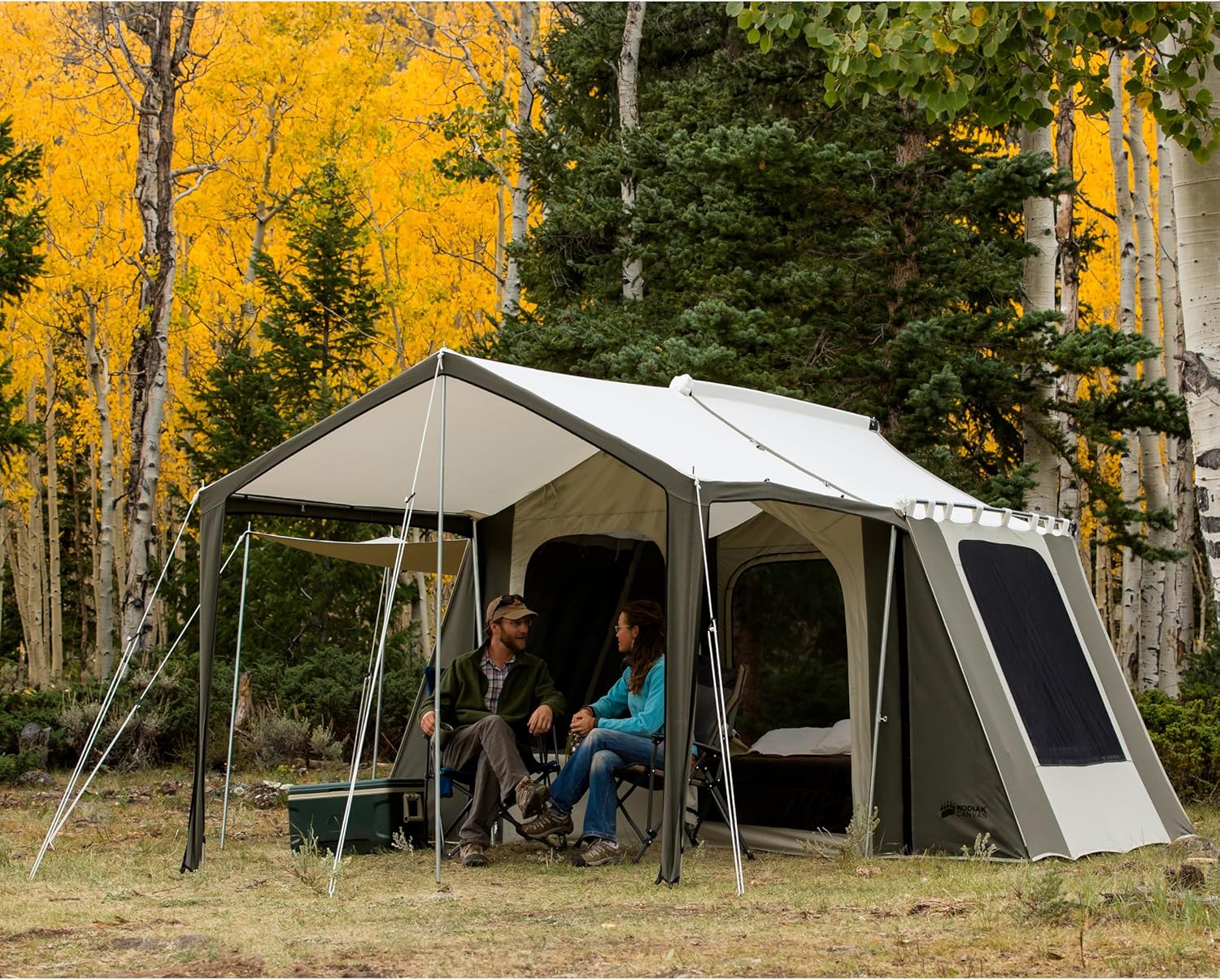
A vertical-walled canvas glamping tent that sleeps six with standing headroom on every wall. With a partner, you can have it pitched in 30 to 45 minutes. We use ours as the communal hot tent on group trips, with a Nu-Way propane stove piped through the stove jack in the corner.
Setup Time
30-45 minutes
People Needed
2 recommended
Floor Area
12' x 9' + 8' x 8.5' awning
Peak Height
7.5 ft
Model 6133 (12x9 with deluxe awning) uses 1 ridge pole, 2 upright end poles, 10 short side poles (5 per side), and 4 taller door-frame poles. The 10x10 cabin variant (model 6121) uses the same frame architecture in a smaller footprint.
Photo of fully assembled Kodiak Canvas Cabin tent at Joshua Tree group campsite
Orientation
Before you begin
Clear the pad, lay out your parts, and spot the color coding so setup flows smoothly.
Choose your spot
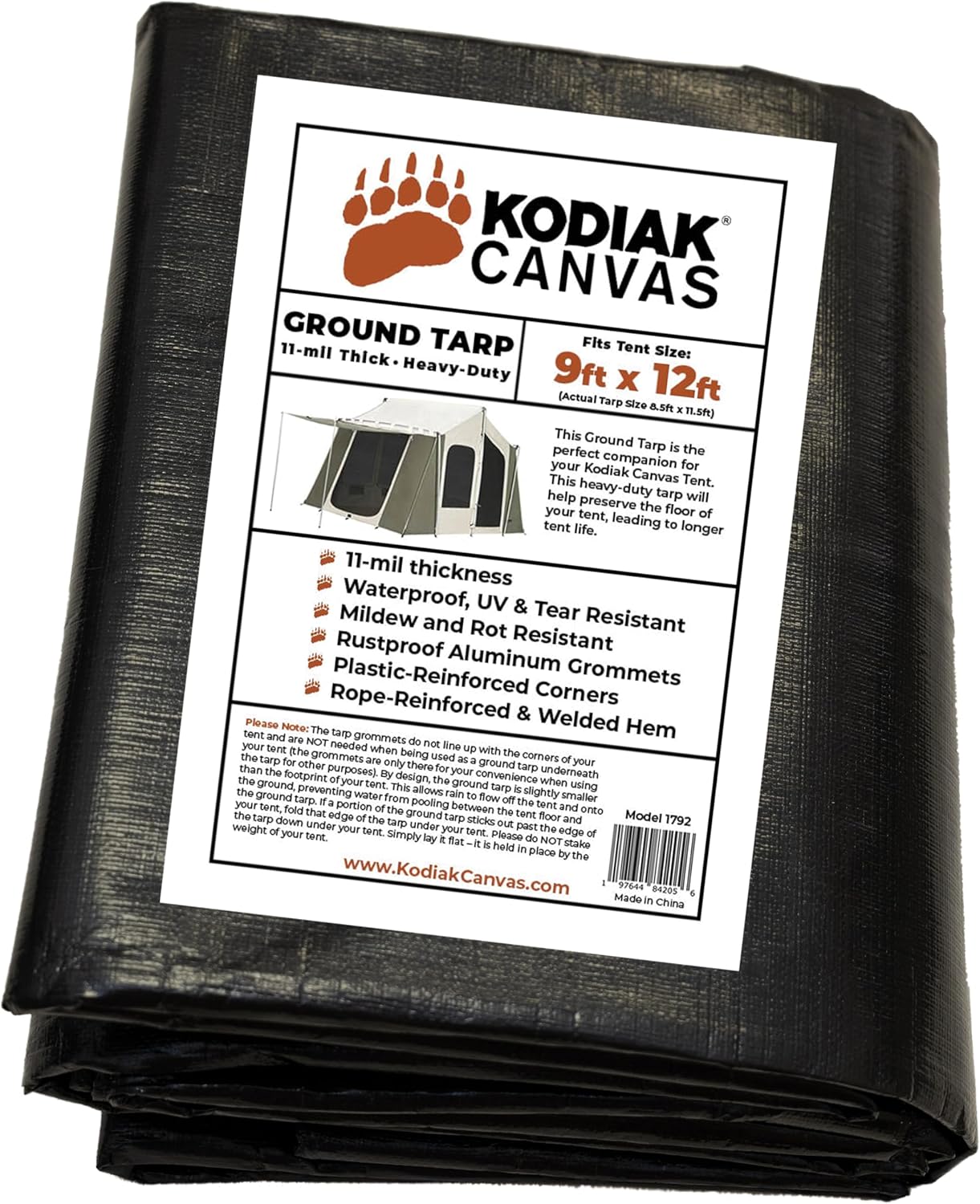
Choose a large, flat area free of rocks, sticks, and debris. The Kodiak Cabin needs at least 12' x 9' for the tent body plus another 4-6 feet in front for the deluxe awning. Sweep the ground or lay a tarp slightly smaller than the footprint to protect the floor.
Photo of cleared, level campsite ready for tent placement
Unpack and verify parts
Lay everything out before you start so nothing is missing mid-setup.
- Tent body with integrated 16 oz vinyl floor
- Ground sheet (sized slightly smaller than the tent footprint)
- Center ridge pole (long, multi-section, runs the length of the tent)
- Two tall upright end poles with pin connectors at the top
- Ten short side poles (5 per side, through the wall loops)
- Four taller door-frame poles (2 at each door end, taller than the side poles)
- Two awning support poles (model 6133 only)
- Heavy-duty 12" steel rod stakes (~16 needed)
- Storm fly with tie-down lines
- Tie-down ropes and tensioners
- Zippered storage bag for tent + separate pole bag
Photo of all Kodiak Canvas Cabin parts laid out and labeled before setup
Mark your front door
Kodiak's pro tip we follow on every group trip: put a small piece of colored tape on the underside of the tent body to mark the awning side. Saves you from staking out the corners only to realize the door is facing the wrong way.
Two-person setup is dramatically easier
Solo setup is possible. We've done it. But the upright end poles take real shoulder strength to push up with the weight of the canvas, and threading the ridge while one person holds it overhead is far less of a fight. Bring a friend.
Stake driver matters
Use a rubber mallet on soft ground (less ringing, bigger strike surface). Switch to a small sledgehammer or screw-in stakes with a power drill in rocky ground. The Kodiak stakes are heavy-duty 12" steel rods and can bend if you swing wildly.
setup
Part 1: Tent Setup
Stake the body first, thread the center ridge, raise the upright end poles, then install the side and door-frame poles and guy them out.
Lay the ground sheet
Lay the ground sheet
Find a large flat place and lay out the ground sheet. Make sure one side has plenty of space — that's where the front vestibule and awning will extend out. Keep the ground sheet slightly smaller than the tent footprint so it doesn't catch rain runoff and funnel it under the tent floor.
Sun and wind orientation
Point the awning east if you can. Morning sun on the awning side warms the tent and dries dew off the canvas. Avoid pointing the door directly into prevailing wind.
Photo of ground sheet laid flat on cleared campsite with space for vestibule on one side
Spread out the tent body
Spread out the tent body
Unfold the tent body and lay it on top of the ground sheet, lining up all four corners with the ground sheet edges. The doors should be at the ends, the long cabin walls along the sides. Double-check your awning side is pointing the right direction before you start staking.
Photo of Kodiak Cabin tent body laid flat on top of ground sheet with corners lined up
Stake the corners and every loop
Stake the corners and every loop
Stake all four corners first to set the square, then work around the perimeter staking every single webbing loop. The Kodiak Cabin has 16 stake points total. Drive each stake at a 45-degree angle away from the tent so the pull is correct when the walls tension.
Don't overstake the corners
Kodiak's pro tip: stake the tent tight, but not tight as a drum. Overtensioning at the corners puts strain on the zippers when you raise the ridge.
Photo of corner stake driven at 45 degrees angled away from the tent body
Lay out the center ridge pole
Lay out the center ridge pole
Grab the large center ridge pole and lay it out next to the tent. This is the longest pole. You're going to thread this through the roof sleeve in a moment. If it comes in sections, connect them now — push the smaller-diameter end of one section into the larger-diameter end of the next until the spring buttons click into place.
Photo of the long center ridge pole laid out next to the tent before threading
Thread the ridge pole through the roof sleeve
Thread the ridge pole through the roof sleeve
Thread the assembled ridge pole through the long fabric sleeve along the center of the tent roof. Push it carefully — the sleeve is fabric and snags on rough pole ends. Push all the way through until both ends of the pole are fully exposed at the front and back of the tent.
Easier with two people
One person pushes the pole at the entry end, the other person guides it from inside the tent so it doesn't catch on the sleeve seams.
Photo of ridge pole being threaded carefully through the center roof sleeve
Position the two upright end poles
Position the two upright end poles
Grab the two tall upright poles. These go on the ends of the tent — one at each door end. The uprights are taller than the side poles and have pin connectors at the top.
Photo of two upright end poles laid out next to the door ends of the tent
Raise the upright poles with webbing over the pins
Raise the upright poles with webbing over the pins
Lift the first upright pole vertically and hook the black webbing strap over the top support pole between the two pins on the upright. The webbing should sit between the pins, not over them. Push the pole upright so the ridge tensions. Repeat on the other end. The canvas roof will rise as you go.
Heavy under canvas weight
The upright pole carries the full weight of the canvas roof when you push it up. Use your legs and shoulders, not your back. Best with two people: one inside lifting, one outside steadying the ridge.
Photo close-up of black webbing strap positioned between the two pins on an upright pole
Install 10 short side poles with guy lines
Install 10 short side poles with guy lines
Install the smaller poles along the long sides of the tent — there are five on each side. Not at the corners, but along the sides. Each pole goes up through a loop in the canvas wall, lifts the wall vertical, and stakes out with a guy line. Work pole-by-pole, alternating sides to keep the tent balanced.
What gives the cabin its vertical walls
These short poles are the trick that makes a Kodiak Cabin different from a wall tent. Each one bows under tension from the guy line and holds the canvas wall perpendicular to the ground, giving you full standing headroom across the entire floor.
Photo of short side pole positioned through a wall loop with a guy line being staked out
Install 4 taller door-frame poles
Install 4 taller door-frame poles
Install the four taller poles at the door ends — two at each end, one on each side of each door. These are noticeably taller than the side poles. They go up through their respective loops and stake out with guy lines the same way the side poles do, but they support the higher cabin wall at the door ends.
Photo of taller door-frame pole installed beside a door with guy line staked out
Verify side view with all poles guy-lined
Verify side view with all poles guy-lined
Walk around the tent and check that all 10 side poles and 4 door-frame poles are guy-lined out properly. The walls should be taut and vertical, no sagging spots, no slack guy lines. Adjust any line that needs more tension.
Photo of the side of the Kodiak Cabin showing all five short side poles guy-lined out and walls vertical
awning
Part 2: Deluxe Awning (Model 6133)
The 12x9 cabin has a generous covered awning that creates a second living room outside the door. Skip this section if you have the 10x10 (model 6121) without the deluxe awning.
Roll out the awning panel
Roll out the awning panel
From the front door side, unroll the canvas awning panel that was tucked along the roof. Lay it flat in front of the tent. It should cover roughly an 8' x 8.5' area in front of the door.
Photo of awning panel unrolled in front of the tent
Stand the awning support poles
Stand the awning support poles
Place one awning support pole at each front corner of the awning. The pole top fits into a grommet or pocket at the awning corner; the bottom rests on the ground. Use the tension ropes to guy each pole out at a 45-degree angle and stake the rope ends firmly.
Photo of awning support pole standing at a front corner with guy line staked out
Tension the awning
Tension the awning
Adjust the guy lines until the awning is taut with a slight pitch downward and outward (so rain runs off the front edge, not back onto the door). Re-check the support poles are vertical and seated firmly.
Photo of fully extended awning showing the slight downward pitch toward the front
stormfly
Part 3: Storm Fly (Optional)
The included storm fly adds full rain protection over the tent body. Skip if the forecast is dry.
Drape the storm fly over the ridge
Drape the storm fly over the ridge
Two people: one on each side of the tent. Toss the storm fly over the ridge so it drapes evenly down both sides. Center it front-to-back so equal fabric hangs off each end.
Photo of storm fly being draped over the tent ridge
Attach and stake the storm fly tie-down lines
Attach and stake the storm fly tie-down lines
Attach each tie-down line from the storm fly to its corresponding loop on the tent. Stake each line out away from the tent body at about a 45-degree angle. Tension snug but not drum-tight.
Kodiak storm fly vs. Springbar Stormfly
The Kodiak storm fly is functional but covers less of the tent than Springbar's Stormfly. The corners stay exposed. In heavy rain, we pitch a separate tarp over the whole tent to keep everything bone dry through the night.
Photo of storm fly tie-down line attached and staked out
Final checks
Walk the perimeter once and confirm these items before moving in.
- All 16 stakes are driven at 45-degree angles away from the tent
- Center ridge pole is fully threaded through the roof sleeve and exposed at both ends
- Both upright end pole pins are seated with the black webbing between them
- All 10 short side poles are guy-lined out and the side walls are vertical
- All 4 taller door-frame poles are guy-lined out at the door ends
- Doors zip and unzip smoothly without binding
- Awning (model 6133) is pitched with a slight downward angle for rainwater runoff
- Storm fly (if installed) is tensioned and staked out at 45-degree angles
Congratulations!
Your Kodiak Canvas Cabin is up. With 108 square feet of floor and 7.5 feet of headroom on every wall, you have a tent you can stand up, walk around, and actually live in. On group trips we run a Nu-Way propane stove piped through the stove jack in the corner. The communal hot tent is where everyone ends up at night.
Gear in This Guide
The other products you saw in this setup.
Features
Vertical Cabin Walls
Unlike dome tents where the walls slope inward, the Kodiak Cabin uses 10 short side poles + 4 taller door-frame poles staked out with guy lines to hold the canvas walls perpendicular to the ground. You can stand up and move around comfortably across the entire floor, not just under the ridge.
Hydra-Shield Canvas
10 oz roof / 8.5 oz wall cotton canvas that's been treated for water and mildew resistance while staying breathable. Reduces condensation compared to synthetic tents and insulates better in both heat and cold.
Five Large Mesh Windows
Mesh window panels on all four walls plus the door provide 360-degree views, exceptional cross-ventilation, and bug protection. The dark mesh gives privacy from outside while letting you see out clearly.
Heavy-Duty Steel Frame
1-inch galvanized steel tube frame with welded corner braces. Reinforced webbing and grommets at every stake point. Designed to take wind that would fold a nylon tent.
Stove Jack Compatible
Model 6133 (and other cabin variants) includes a sealed stove jack panel in the corner. We use ours with a Nu-Way 3500 propane stove on group trips. Always verify your specific model's stove rating before use.
Quick reference
Floor Area
12' x 9' (108 sq ft) — model 6133
Floor Area (10x10)
10' x 10' (100 sq ft) — model 6121
Peak Height
7.5 ft
Side Wall Height
5.5 ft
Awning
8' x 8.5' deluxe awning (model 6133)
Total Weight
~112 lbs (tent + poles + stakes)
Canvas
Hydra-Shield cotton (10 oz roof / 8.5 oz walls)
Floor
16 oz vinyl, polyester-reinforced, seamless
Stakes Included
Heavy-duty 12" steel rod stakes
Poles
1 ridge + 2 upright + 10 side + 4 door-frame + 2 awning = 19 total (6133)
MSRP
$949.99 (model 6133)
Manufacturer
Kodiak Canvas (kodiakcanvas.com)
Troubleshooting
The cabin walls won't stand vertical
Check that all 10 short side poles + 4 door-frame poles are seated in their wall loops and guy-lined out with proper tension. If any pole is loose or its guy line is slack, the wall on that side will sag. Re-tension each guy line.
The upright end pole won't raise the canvas
The corners aren't staked taut enough yet, or the ridge pole isn't fully threaded through the roof sleeve. Check that the ridge pole runs all the way through and is exposed at both ends. Re-check corner stakes are secure before pushing the upright up. Make sure the black webbing is between the two pins on top of the upright, not over them.
The awning is dipping in the middle
The two awning support poles need to be tensioned more or moved slightly outward. The awning should pitch downward toward the front so water runs off, not pool in the middle.
Stakes won't hold in rocky ground
Switch from a rubber mallet to a small sledgehammer. In very hard ground, use Kodiak's screw-in stakes with a cordless drill, or pre-pilot stake holes with a piece of rebar. In sandy or soft soil, drive at a steeper 60-degree angle and use longer stakes or deadman anchors.
Condensation is forming inside the tent
Crack the mesh windows for ventilation, especially on trips longer than two nights. Canvas breathes better than nylon but it still needs airflow. Sleeping six people in a sealed tent overnight will produce moisture no matter the fabric.
The tent smells musty after storage
The tent was likely stored damp. Set it up in direct sunlight for a full day and let the canvas dry out completely. For active mildew, use IOSSO Mold and Mildew Stain Remover (per Kodiak's care instructions), then re-treat the cleaned area with a silicone-based water repellent like Kiwi Camp Dry.
I can't fit the tent back into the storage bag
Lay the storage bag flat on the ground and use its width as a guide for how wide to fold the tent before rolling. Roll tightly from one end and compress the roll with your knees before sliding into the bag.
Can I use the stove jack with a propane stove?
Yes, but only with stoves that are rated and properly piped for stove jack use. We use a Nu-Way 3500 propane stove on our group trips with the pipe routed through the stove jack panel. Always verify the model is rated for stove use and use a smoke + carbon monoxide detector inside.