Lost Horizon Air & Foam Camping Mattress
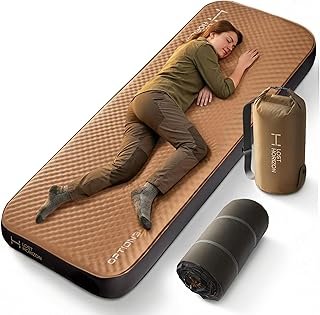
- Best for:
- Front-country car or truck camping, overlanding, RV/cot setups and couples/families who want near-mattress comfort at a budget price
- Skip it if you want:
- Weight- or space-conscious activities such as ultralight backpacking, long-distance hikes, or very small tents where a large queen pad won't fit
Main tradeoff: Very heavy and bulky for a two-person pad (queen ~17.6 lb), so poor packability
Before you buy
Why it works
- Exceptional comfort from a 4–4.5″ foam + air hybrid that many users say feels like a home mattressOutdoorGearLab
- Includes a pump sack and inflator options that make inflation/deflation straightforwardShopAbunda
- Very strong value — much cheaper than premium two-person pads while delivering comparable plushnessOutdoorGearLab
- Comes with pump and stuff sack (a feature usually reserved for pricier pads)OutdoorGearLab
Tradeoffs
- Very heavy and bulky for a two-person pad (queen ~17.6 lb), so poor packabilityManufacturer
- Self-inflation is weak for a pad this thick — the included pump is effectively required to reach full firmness quicklyOutdoorGearLab
- Manufacturer R-value (R-13) appears overstated; independent testing and user experience point to a lower effective R (~6–8)OutdoorGearLab
- Rare reports of valve or seam failures/leaks after extended useShopAbunda
Details
About the Lost Horizon Air & Foam Camping Mattress
The Lost Horizon Air & Foam Camping Mattress is a plush air-and-foam hybrid that has become the community's favorite value alternative to premium car-camping pads like the Exped MegaMat and NEMO Roamer. A supportive foam top over an adjustable air chamber delivers 4.5 inches of cushion; it self-inflates, with an optional pump to fine-tune firmness. This is the single (80 x 28 in, 9 lb) — the most popular size — and the mattress is also offered from a slim single up to an 80 x 60-inch queen. The tradeoff is weight and pack size. At 9 lb it is heavier and bulkier than a slim self-inflating pad, relying on an air-and-foam build rather than a compact foam core. For front-country car camping, where you drive to the site, most owners consider that a fair trade. What campers are saying (from r/camping and r/CampingGear): owners repeatedly call it the most comfortable camping mattress they have used, with several saying it beats their bed at home, and praise it as easy-inflating, firmness-adjustable, and kind to side sleepers. It is most often recommended as the cheaper-but-equal alternative to the Exped MegaMat (“every bit as good as the Exped, grab it”), and several note that with a pump to evacuate the air it actually rolls down smaller than tri-fold foam mattresses. The main caveat raised: at least one multi-year owner reported the mattress developing air leaks through the fabric after about two years, so long-term durability is worth watching.
Specifications
- Weight
- 9 lb
- Packed size
- roughly 18 x 18 inches (queen, depends on rolling/compression)
- Materials
- 30D stretch polyester top, 75D polyester ripstop bottom, solid open-cell foam core bonded to inflatable bladder
- Colors
- brown, blue
- Changes from the last model
- No significant model changes noted since release
Questions (6)
- Is it worth the price over cheaper alternatives?
- For frequent car-campers or anyone prioritizing mattress-like comfort, the Lost Horizon offers strong value compared with premium two-person pads — you get similar plushness and included pump/bag for a fraction of the cost; if packability and weight matter, a lighter, more expensive pad may be a better choice.
- How does it hold up long-term?
- Most owners report solid short- to mid-term durability, but isolated reports exist of valve or seam leaks after extended use; handle valves gently, use a groundsheet, and keep proof of purchase in case of replacement needs.
- What size/capacity should I get?
- Choose the size that fits your tent or vehicle space: queen is 80×60″ (supports up to 500 lb) for two adults; double/full and single/cot sizes are available with lower stated maximum supported weights.
- Can I use it in the rain or for winter camping?
- Use it inside a tent with a footprint or under a tarp for rainy trips — the pad itself is not waterproof and the foam will absorb water; for winter camping it can be warm with a proper sleeping bag, but independent testing suggests it functions as a 3-season pad rather than a guaranteed 4-season option.
- How do I clean and maintain the pad?
- Wipe off dirt, air-dry thoroughly before storage, store deflated in a cool dry place, avoid leaving inflated in hot sun, and patch punctures/valve leaks with appropriate repair kits if needed.
- What comes in the box?
- Options include pad-only or pad + pump kits; kits typically include the pad, a pump sack (manual inflator) and a storage/stuff sack; an AC/battery pump may be sold separately or in some bundles.
Weather and conditions
Care and warranty
Care
- keep pad dry and clean; air-dry thoroughly after use in damp conditions
- store deflated in a cool, dry place
- use a footprint or tarp on rough ground and handle valves gently when inflating/deflating
What tends to wear out
- valve or seam leaks
- punctures to outer fabric if used without groundsheet
Durability
- majority report no early leaks after multiple uses; isolated reports of internal valve membrane tearing after extended use (rare)
Warranty
Company has provided replacements in at least one reported case, but no public, detailed warranty length or terms were found; buyers should retain proof of purchase and inspect on arrival.
Sources
“For the price, this double pad is hard to beat.”
Have you used the Lost Horizon Air & Foam Camping Mattress?
Tell other campers how it worked for you.
Last updated July 11, 2026